
Briefings / Local Business
What Creative Studios Can Share Under One Roof
Photography, design and sound can become a joint service. An imagined exhibition shows what neighbouring studios need to agree on before taking a commission together.
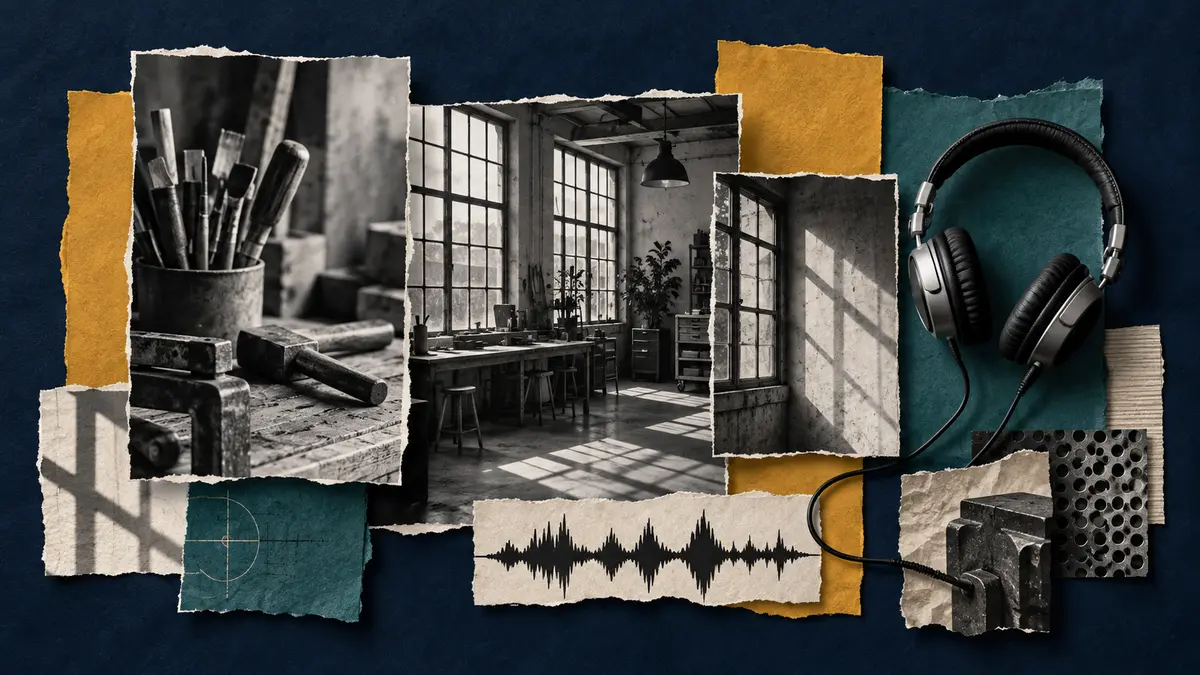
A photographer, a designer and a sound specialist can walk through the same door every day without ever completing a joint commission. Proximity makes introductions easier, but it does not explain what to offer a client, who will speak to them or how separate contributions become a finished piece of work. For a creative workspace, that distinction matters: occupied rooms show that companies are present, while a shared project shows whether those companies can agree on a specific result.
On 29 May 2025, Interfax reported plans for creative clusters in four more cities in Russia's Far East, drawing on Yakutia's experience. Deputy minister Elvira Nurgalieva discussed support for creative teams and access to external markets. These were plans extending to the end of 2026, not four facilities that had already opened.
A shared address does not create a shared service
Every small creative business has its own way of working. A photographer may organise shoots around a subject's availability, a designer around approval of a layout, and a sound specialist around recording time. These activities can complement one another, but their schedules will not align automatically. A client seeking a combined result is unlikely to want to untangle every internal dependency. They need an understandable offer, while the practitioners need to deliver it without compromising the quality of their individual contributions.
A shared workspace is useful as somewhere to discuss that offer before making a promise to the client. A brief introduction establishes who does what. A working conversation establishes something else: whether the specialists suit a particular project, have time for it and share an understanding of the result. Rejecting an unsuitable combination can also be a useful outcome. It avoids presenting neighbours as a ready-made team.
One imagined commission makes the question concrete
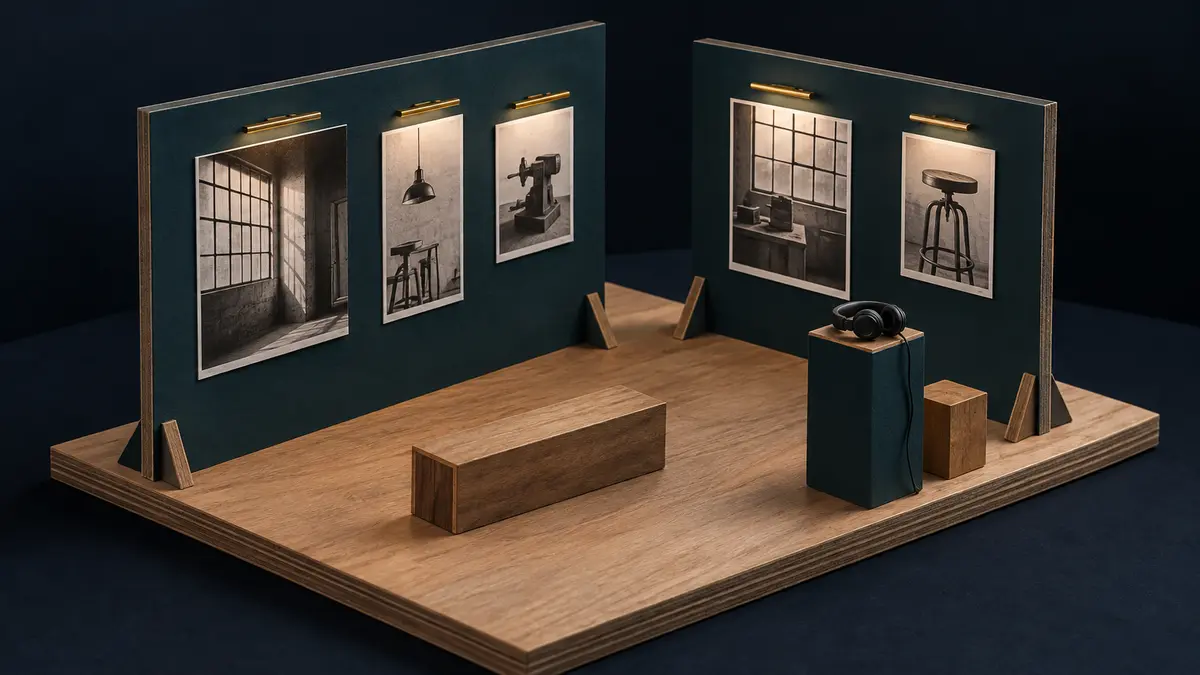
Imagine a small exhibition about the history of a neighbourhood business. Its organiser needs photographs, display design and an audio element. This is a fictional example, not a project undertaken by residents of a particular cluster. It helps show how three independent contributions become one visitor experience. A strong photograph, an expressive layout and a clear recording do not individually guarantee that the exhibition will feel coherent.
The first shared task is to understand what visitors should learn and how they will move through the material. That affects the selection of images, the length of explanations and the role of sound. If each practitioner starts with a familiar format, coordination may arrive too late: the photographs are ready, there is too little room for text, and the recording takes longer than a visitor spends at the display. An early conversation is not about suppressing creative independence. It is about understanding the connections between the parts.
A clear brief gives an introduction a purpose
The organiser of the imagined exhibition might begin by asking for something contemporary and engaging. That is enough for an introduction, but not for production. The designer needs to understand the material and display conditions; the photographer needs to know which people and objects will be photographed; the sound specialist needs to know what the visitor will hear. A shared conversation turns the aspiration into questions the client can answer without knowing the professional vocabulary of every discipline.
A detailed brief need not settle every artistic decision in advance. It establishes a common frame within which proposals remain possible. For example, the team could discuss whether each display needs a separate recording or whether one audio story would work better. The point is not to select a universally correct format, but to see how the decision changes everyone else's work. The number of recordings relates to the number of listening points, whose location relates to the exhibition's overall composition.
The conversation also reveals gaps that meeting another neighbour will not close. If the organiser lacks access to the necessary archival material, the presence of a good designer does not create it. If the exhibition period is undecided, conveniently adjacent studios do not turn it into a confirmed date. A shared workspace can accelerate discussion, but it cannot replace decisions that remain outside the team's control.
Questions for the fictional exhibition
- What story should the visitor understand, and which materials are already available?
- Which parts of the result depend on one another?
- Who answers questions and gathers comments on the client's side?
- When will the separate parts first be considered together?
These are questions for an invented project, not cluster admission rules or a contract template. Their purpose is to make the shared task visible. When participants understand it in the same way, they can more easily decide whether a joint team is necessary or whether the commission should simply go to a known specialist who can complete it independently.
Neighbouring studios have different working rhythms
A creative workspace might contain facilities useful to several companies: a place to review material, a shooting area or a room for client conversations. Their value depends on how well the space suits the task. An attractive common hall may suit a presentation without being suitable for sound recording. A vacant table does not mean a confidential project can be discussed beside it without disruption. These distinctions are better understood before inviting the client.
For the fictional exhibition, the photographer might need a quiet object shoot while the designer discusses a draft layout and the sound specialist listens to a recording. If all expect the same room at the same hour, shared infrastructure becomes a source of competition. A booking helps only when everyone understands what use includes: preparation, the activity itself and returning the room to a condition suitable for the next person.
That creates a concrete role for the workspace operator. The operator does not need to solve the residents' artistic problem to explain access to a shared room and answer questions about its capabilities. This service is more modest than a promise to develop an entire industry, but it directly affects the working day. The company knows what it can count on, and the client does not become an accidental participant in a dispute over an occupied room.
The client needs a coherent conversation
Three independent practitioners can retain their own names while agreeing on understandable communication. The client should not have to work out where to send a comment that concerns both a photograph and its placement. The team needs a way to receive that question and discuss it with the relevant people. This does not automatically authorise one person to decide for everyone: coordinating a conversation and having authority to make decisions are different things.
In the imagined exhibition, the organiser asks for one display to become more expressive. The photographer might suggest a different image, the designer a change of scale, and the sound specialist a clearer connection to the narration. If each answers separately and treats their proposal as approved, the client receives incompatible promises. A joint response explains the proposed approach as a whole and identifies questions still requiring a decision.
It is also useful to distinguish an invitation to discuss an idea from confirmation of a change. Someone might propose an improvement without knowing whether colleagues have time to implement it. Being able to talk quickly in the neighbouring studio helps establish that, but only if the conversation actually happens. Physical proximity makes communication easier; it does not establish that everyone has already agreed to a proposal mentioned to the client.
Review the parts together before they are finished
When separate contributions meet for the first time just before an opening, inconsistencies become particularly inconvenient. A photograph may work in an independent series but lose its meaning beside the chosen heading. A recording may contain a detail absent from the visual account. This is not necessarily an individual practitioner's mistake: sometimes the problem lies in combining good parts prepared with different understandings of the whole.
An early joint review allows the combination to be discussed while decisions can still change. For the imagined exhibition, that review could use one trial fragment: an image, a caption and an audio excerpt. It does not represent the entire exhibition or establish that the remaining material is ready. It does help reveal whether participants understand the rhythm, tone and amount of information reaching the visitor in the same way.
The client needs to understand what is being shown at this stage. A draft fragment addresses a particular question; it is not an invitation to judge every detail as final. Otherwise the conversation may become absorbed in temporary elements and miss the central combination. The team's ability to present work in progress clearly is a service in its own right, not something replaced by an address in a well-known creative workspace.
After the review comes the handover
For the exhibition organiser, work continues after the creative team has finished its contribution. The organiser will show the material to visitors, answer ordinary questions and need to know whom to contact about a change. Handover therefore includes not only files or objects but a clear explanation of what they contain. Someone absent from the working meetings should understand which version is intended for use and how its parts relate to one another.
In the fictional exhibition, this becomes especially clear if the organiser receives several image and recording variants produced during discussions. Without explanation, an old caption could accidentally be paired with a new photograph. The team can prevent that misunderstanding by presenting the final package as a whole and separating it from working material. That completes the collaboration from the client's perspective: they receive a usable result, not the history of internal approvals.
A shared portfolio should identify its contributors
Once the imagined exhibition is complete, the team has work it can explain to another prospective client. A common result does not mean that each participant independently made everything. A clear presentation identifies the photographer's, designer's and sound specialist's contributions. This helps a future client see not only an attractive outcome but the services they can actually discuss with a particular practitioner.
Participants decide which materials can be shown in relation to their own project. No legal terms for using images or recordings are proposed here. The simpler organisational point is that permission for public presentation cannot be inferred merely from having worked together. If the team expects to present the result to potential clients, it needs to establish which parts are intended for that purpose and which remain within the completed commission.
The description itself also deserves attention. Saying that someone created an exhibition can conceal very different contributions, from a single photograph to the design of the entire display. Accurately explaining a role does not diminish the achievement. It makes it more convincing to a client assessing whether the specialist suits a new task. A small business builds its reputation not only on attractive material but on the match between its presented experience and what it can offer.
Explain the value of proximity to an outside client
Participants in a creative workspace may know one another well. Outside it, those relationships are unfamiliar. A client need not be interested in the number of studios in the building or how often their occupants meet over coffee. They are more likely to want to know which problem the collaboration can help solve. An account of specific shared work translates an internal relationship into a result that someone who has never visited the site can understand.
For the fictional exhibition, that account could follow the process from selecting material to combining image and sound. It explains why the practitioners worked together instead of merely listing three occupations. A past result should not, however, be presented as a ready-made answer for every new client. Another museum, company or community organisation might need a different scale, different material and an entirely different way of engaging visitors.
The workspace operator could help make such work visible, perhaps by holding a gathering where teams explain completed projects to an invited audience. This is a possible activity, not a confirmed service of the clusters mentioned in the report. Its value depends on the conversation. The presence of potential clients does not mean orders have arrived, but specific questions may reveal whether the offer makes sense to people outside its creators' circle.
A useful network leaves room for outsiders
Proximity is convenient, but the right specialist will not necessarily work in the same building. A team choosing collaborators solely because they are neighbours may miss a better combination. Shared premises are useful as a starting point for relationships, not a boundary beyond which collaboration stops. The client cares about the result, so the ability to bring in an outside practitioner can be more valuable than presenting the internal group as entirely self-sufficient.
The imagined project might need someone experienced in handling historical material who is not among the neighbours. That does not make the creative workspace useless. On the contrary, an established team may be better able to explain the missing contribution. Distinguishing known capabilities from the expertise still needed helps the group seek a specific partner instead of simply expanding a contact list.
External relationships remain important after delivery. A client may return with a task for which the original team is too large or lacks a necessary skill. Preserving trust does not necessarily mean repeating the same group. Sometimes it is better to refer the client to one participant or explain honestly that another specialist is needed. A shared reputation benefits from a close match to the task, rather than an attempt to keep every commission within one address.
A repeat project reveals more than an occupied room
During their first collaboration, participants learn how colleagues discuss uncertainty, present unfinished work and respond to changes. That experience can make another project easier: some questions already have a known recipient, and differences in working habits are less surprising. Repetition is not valuable in itself, however. A new task still requires a review of the team and available time, even when the previous collaboration left a good impression.
Evaluating a creative workspace therefore involves more than counting occupied rooms. That number describes the use of property, but it does not show which relationships developed between companies or what they delivered for clients. A more informative account needs examples of actual work, an explanation of roles and evidence of continued collaboration. This article attributes no such outcomes to the announced facilities; it considers the observations that would make their usefulness discussable after operations begin.
Plans for new clusters provide a reason to consider shared infrastructure, but its commercial substance emerges in everyday relationships. A room can provide somewhere to meet, equipment a way to complete part of a task, and proximity a reason to get acquainted. Turning those conditions into an offer to a client remains the participants' work. That is the distinction between a collection of separate studios and a place where independent businesses know how to create something together.
Leave a comment