
Briefings / Local Business
Making Space for Smaller Bouquets
A compact bouquet can offer a distinct design. Clear descriptions, shared flower stocks and agreed substitutions help a florist turn customer preferences into a workable range.
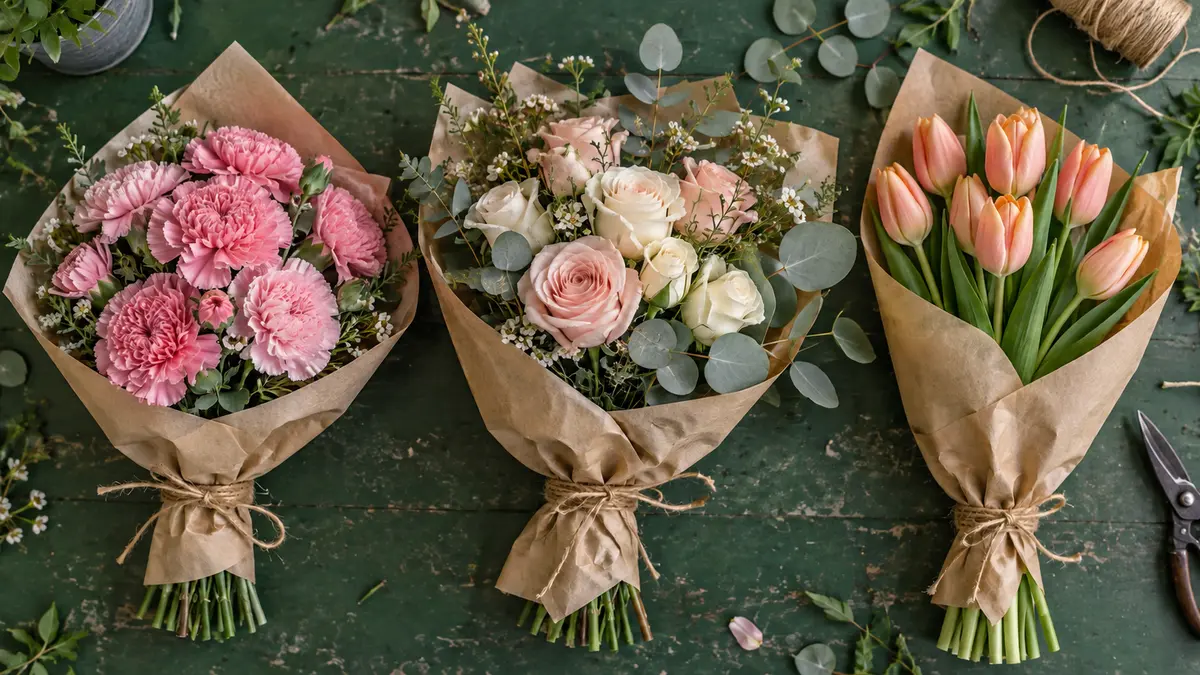
A request for a small bouquet does not always mean the same thing. A customer may care about a particular flower, a combination of colours, ease of carrying or the overall shape of the arrangement. If a florist hears only a wish to spend less, the suggested alternative may remove the very detail that brought the customer into the shop. Assortment planning begins with understanding what matters in the chosen bouquet.
In June 2026, Gazeta.Ru reported, citing Kommersant, that customers in Russia were choosing less elaborate bouquets more often. The underlying report also described a wider offering of affordable arrangements, including designs using greenery. That is a reason to examine an individual shop's range, rather than assume that all its visitors now want identical bouquets.
Find out what the customer wants to keep
Before suggesting an alternative, establish the essential features of the order. For one person, this is a particular flower; for another, a restrained colour palette; for a third, a bouquet that will fit a small vase. These requirements can overlap, but their relative importance differs. A few precise questions provide more useful information than an assumption about someone's preferences based on the amount they want to spend.
The conversation need not become a long questionnaire. Establish the bouquet's purpose, the desired size and the features the customer would prefer not to change. If they show a photograph, ask what attracted them: the colours, density, shape or individual flowers. The same photograph can serve as a very different reference for two visitors, so the visual alone does not settle the brief.
Separate requirements from flexible details
The order record can distinguish confirmed requirements from acceptable options. Keeping a pale colour palette might be essential, while the particular decorative foliage remains open to discussion. Staff should not assign that flexibility on the customer's behalf. Explain the proposed change first and obtain agreement. This helps another florist continue the work without asking every question again or inventing a different interpretation of the arrangement.
Make the differences between options visible
A range of bouquets is useful when customers understand the differences. Labels such as small, medium and large do not always provide enough information. Arrangements can vary in the number of principal flowers, density, height, wrapping and the role of foliage. Highlighting these features helps people choose the result they want, rather than merely a position in an abstract ladder of sizes.
A separate product is not necessary for every possible combination. Too many closely related options complicate the conversation and create more promises that staff must keep up to date. A short, understandable range may work better if each bouquet has a distinct purpose. One might suit a compact presentation, another emphasise individual flowers and a third offer a loose silhouette. These are examples of organising a range, not a universal selection for every shop.
Present greenery as part of the design
Foliage can be an important component of an arrangement, establishing direction, connecting colours and creating space around the principal flowers. Its role should nevertheless be visible. Someone expecting a dense bouquet of particular flowers may not regard a looser composition as equivalent, even if it occupies a similar volume. Matching the external size does not establish that the contents or impression are the same.
If the shop offers fewer principal flowers with more prominent greenery, present that as a design in its own right. The photograph, description and conversation at the display should describe the same bouquet. The customer then chooses that character rather than discovering a change at collection. A clear description also helps the florist, who should not have to guess what the person taking the order has promised.
Connect the photograph to the available option
A catalogue image creates expectations before a customer contacts the shop. Check which size and composition it represents. If one photograph accompanies several substantially different options, explain the differences beside the selection. Otherwise, a customer may interpret the largest arrangement pictured as the result of any order, leaving staff to discover the mismatch only when the bouquet is handed over.
Seasonal substitutions also require attention to the image. When the original composition is no longer available, an old photograph should not silently describe its replacement. The shop needs a clear way to update the listing or agree the differences. This does not mean photographing the entire catalogue every day. It means reviewing changes that materially affect the recognisable appearance of a bouquet and the customer's decision.

Account for flowers shared across designs
One flower type may appear in several arrangements. This can suit a compact range, but it requires a shared account of the available quantity. The remaining stock cannot be promised independently to every catalogue option. If several confirmed orders rely on the same flowers, availability for the next bouquet depends on all those commitments, rather than sales of the selected design alone.
Keep the quantity allocated to agreed orders separate from the quantity still available to offer. The total number of stems received is not necessarily the number suitable for a particular arrangement. A florist assesses their actual condition and fit with the order. The working record should reflect that assessment, rather than assume that every stem delivered can be used in the same way.
A fictional shared-stock example
Imagine a fictional shop with sixty usable stems of one flower type after inspection. Four confirmed bouquets need seven stems each, or twenty-eight in total. Two other orders require eleven each, adding twenty-two. Fifty stems are therefore allocated and ten remain free. This is a simple quantity example, not a description of a real shop or an instruction for designing a bouquet.
The remaining ten stems can support one additional seven-stem option, leaving three unallocated. They cannot support a new eleven-stem option. The shop cannot assume it can accept both additional orders merely because both bouquets appear in its catalogue. The designs draw on shared stock, not separate quantities that exist independently behind each photograph. An availability display needs to preserve that relationship.
If some material later proves unsuitable, update the calculation before accepting another commitment. Inspect a new delivery before adding it to usable availability as well. The example says nothing about price, profit, keeping quality or future sales. It shows only the relationship between flowers already assigned and what can still be offered without promising the same quantity twice.
Agree substitutions before assembly
An unavailable element does not always require abandoning the whole order. A customer may be willing to choose a different flower, change a shade or select another arrangement. Agreement should come before the alteration becomes a finished result. Explain which characteristic will remain, which will change and how the proposed option differs from the original. A broad promise to make something roughly similar is often insufficient.
For recurring orders, acceptable substitution boundaries can be discussed in advance. One customer may welcome seasonal flowers within a fixed palette; another needs a specific flower with no replacement. Both approaches are possible when they reflect the actual agreement. Permission to be flexible is not permission to alter every detail. The person taking the order must pass on the agreed limits, not their impression of how accommodating the customer seems.
If the customer cannot be reached, a missing reply does not become consent. The shop needs a way to handle the unresolved order without inventing confirmation. For example, keep the question open and pass it to the responsible colleague. The precise response depends on the arrangement and the time remaining before collection. Whatever the process, the record should show that a decision is outstanding rather than conceal the uncertainty.
Test a manageable selection
Changing the whole catalogue at once makes the result harder to interpret. A shop exploring more compact arrangements can start with a limited set of distinct options and identify the questions it wants to answer. Do customers understand the differences? Can florists reproduce the intended appearance consistently? Does the description match the bouquet handed over? These observations concern the quality of the offer and do not require a promised increase in revenue.
Record the comparison conditions at the outset. An ordinary weekday, a holiday and a major local event create different purchasing situations. Results from a few unusual days cannot automatically describe a normal week. Also note whether every option being tested was available. A rarely selected bouquet may have been absent for much of the period, rather than less attractive to visitors.
A small trial need not deliver a final conclusion about the entire market. Its purpose is to improve a specific range. Staff may discover that two options look too similar in photographs or that a name fails to explain the shape. These findings are useful in their own right. They identify what to clarify before expanding the offer and maintaining more listings, descriptions and working examples.
Record reasons without guessing
The number of bouquets sold describes the outcome of choices but does not always explain their causes. Brief, voluntary customer comments can reveal whether size, colour, a particular flower or convenient collection mattered. Record what people say rather than assigning a motive from their appearance. If a visitor gives no explanation, the reason remains unknown. That is more accurate than filling the gap with a confident staff assumption.
It is also useful to note requests for which no suitable option was available. Visitors might be seeking small bouquets in a particular palette while the range offers only large ones. Alternatively, their concern may be collection time rather than composition. These situations suggest different responses. Classifying every unsuccessful enquiry as too expensive can hide an issue the shop could address through description, shape or collection arrangements.
The conversation should not become a collection of unnecessary personal details. Evaluating a range usually requires the relevant request and the outcome of the discussion. The private circumstances of a gift, recipients' names and detailed relationship histories do not become useful merely because they can be recorded. Keep the working observation connected to the bouquet and the choice, rather than the customer's biography.
Help florists reproduce the offer
A good photograph does not replace a clear working description. If a design is sold regularly, staff should share an understanding of its principal features: composition, shape, focal details and agreed presentation options. This does not remove creative work. The description records what has been promised while leaving professional execution to the florist. Without a common reference, different shifts may interpret the same order as different tasks.
Share an updated design with the people taking orders, assembling bouquets and handing them over. Changing only the internal example leaves the old promise in the catalogue; changing only the photograph leaves the old brief in the workroom. Check the complete sequence for one specific design. Its name, available option, order record and finished result should refer to the same current version of the offer.
An individual variation agreed with a customer need not become a new standard design. Keep it with the specific order so that one request does not change expectations for every subsequent bouquet. Conversely, a repeated alteration may justify reviewing the main description. Make that decision explicitly rather than allowing the range to drift away from its catalogue through unnoticed changes by individual employees.
Check the bouquet before collection
The final check connects the finished arrangement to a specific order. Look beyond its general appearance to the agreed features: size, palette, principal flowers and individual requests. If a substitution was confirmed during the work, use the updated record at collection. Otherwise, a correctly revised bouquet may be compared mistakenly with the original option, or an unapproved difference may pass unnoticed.
When several orders look similar, appearance alone is not a reliable identifier. Two bouquets of one design can have different agreed details. A clear connection between the finished bouquet and its order helps prevent a mix-up at collection. A working identifier need not expose personal information. What matters is that an employee can confidently match the product to the record before handing it over, rather than checking after the customer leaves.
If a mismatch is found, establish its nature first. An assembly error, an outdated description and an unrecorded agreement require different responses. Correcting the individual bouquet promptly matters, but it is also useful to identify where the problem began. Otherwise, the next order may repeat it. A short note about the issue and the subsequent description change can turn one incident into a practical improvement.
Collection offers an opportunity to ask about the result without steering the customer toward a positive assessment. Asking whether the size or colour matches expectations is more specific than inviting general praise. Describe any difference the customer identifies accurately. Not every comment requires redesigning the range, but several similar observations may show that a photograph, name or explanation repeatedly creates a different expectation.
An absence of comments does not establish that every later order will be received in the same way. Each arrangement has its own recipient and confirmed requirements. The final check remains part of the work even for a popular design that staff have assembled many times. Familiarity makes execution easier, but does not remove the need to consult the current record and inspect the particular finished bouquet.
Review the range through clear questions
After the trial period, return to a short set of questions. This helps distinguish customer observations from internal record problems. If an arrangement is difficult to choose from its photograph, improve the presentation. If it is difficult to reproduce, clarify the working example. If shared material is insufficient, review availability. A general verdict that an option did not work does not identify the next action.
- Do visitors understand the differences between the bouquets offered?
- Do photographs match the composition and size of the selected option?
- Are shared stems accounted for across all confirmed orders?
- Are permitted substitutions recorded and specific changes agreed?
- Do design updates reach everyone involved in the order?
- Has the customer explained a decision not to buy, or is the reason still unknown?
More restrained customer choices do not require every bouquet to resemble the last. They give the shop a reason to explain its options more clearly and connect its promises carefully with execution. A well-organised range preserves choice, makes real differences visible and gives florists a clear brief. That consistency helps a small shop change its offer without losing the character of its arrangements.
Leave a comment