
Briefings / Trade
The Inland Journey Behind a Container Delivery
A port arrival is only part of an importer's journey. Rail connections, inland terminals and warehouse receiving times determine when the goods become useful.
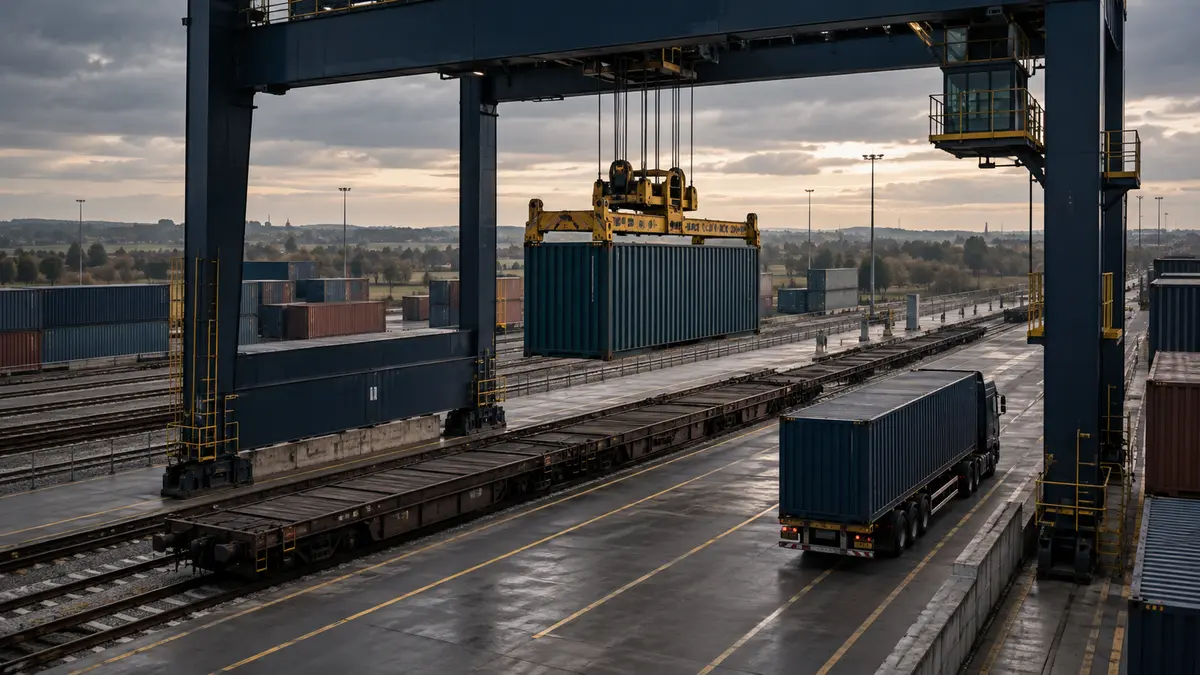
A container can have reached the right country and still be several decisions away from the shelf. Between the vessel and the warehouse sit a port, a possible train journey, an inland terminal and a final road delivery. For the business waiting for the goods, the useful question is not simply where the box has arrived. It is when its contents can enter the receiving operation and become available to customers.
On 22 September 2025, Reuters reported CMA CGM's announced acquisition of Freightliner UK Intermodal Logistics in the United Kingdom. Completion was expected in early 2026. The company's announcement described rail and road operations and inland terminals, with Freightliner intended to remain an independent, multi-customer operator. Regulatory approvals were still required.
That proposed combination provides a useful starting point for examining inland delivery. Bringing businesses under one owner can create opportunities to connect services, but a corporate announcement is not a new timetable. Customers still need a journey that fits their destination and their working day. The analysis below considers those connections through an imagined importer, rather than describing a particular Freightliner service or promising an outcome from the transaction.
The destination is a receiving operation
Imagine a wholesaler importing household goods for several regional shops. Its warehouse is inland, away from the port. The stock is useful only after the warehouse has received it, checked it and made it available for onward orders. A message saying that the vessel has arrived is welcome, but it does not yet establish when the wholesaler can tell a shop that its goods are ready. The remaining journey has to be considered alongside the warehouse's ability to receive the load.
This distinction changes the meaning of a fast transport offer. A shorter journey to a terminal might not produce an earlier usable delivery if the final vehicle reaches the warehouse after its receiving window. Conversely, a later arrival that matches an available unloading period may fit the business better. These are not arguments for accepting delays. They explain why an importer needs a description of the whole journey, including the point at which transport meets the customer's own operation.
The warehouse also has work that is not visible from the port. Staff may already be unloading other deliveries, preparing shop orders or making room for a bulky consignment. A revised arrival estimate is therefore more than a change on a tracking screen. It changes how the receiving team uses space and time. An inland service becomes commercially useful when its information can support those decisions, rather than simply report that another transport stage has finished.
Rail and road answer different geographical questions
For the imagined wholesaler, there are two possible outlines: a road journey from the port to the warehouse, or a rail movement to an inland terminal followed by a shorter road leg. Neither outline, by itself, establishes which offer is preferable. The choice depends on the actual origin and destination, available services, connections and receiving arrangements. Drawing a straight line between a port and a town leaves out much of what determines the workable route.
The rail option separates a shared trunk movement from individual deliveries. Containers can travel together over the main inland distance and then leave the terminal for different destinations. The road leg connects that common movement to a particular warehouse gate. This is why the inland terminal's location matters in relation to customers, not just in relation to the railway. A convenient place for trains is not automatically a convenient starting point for every final delivery.
A direct road option combines the inland movement differently. It may avoid an inland transfer, while still depending on collection arrangements at the port and access at the destination. The point of comparing it with rail is not to nominate a universal winner. It is to understand what each offer includes and where its constraints sit. A business with one destination and irregular shipments may ask different questions from another with recurring volumes spread around the same inland area.
Connections turn individual movements into a journey
Suppose the fictional wholesaler is offered a rail departure followed by delivery on an agreed receiving day. That proposal depends on the container being available in time for the departure, the inland movement taking place and the final road leg fitting the warehouse's schedule. Each part can look reasonable when considered alone. Their usefulness depends on whether they join up. The customer is buying access to a destination, not a collection of unrelated movement descriptions.
A changed vessel arrival is one way that the connection could be affected. The relevant question is then what happens to the inland plan. Is the proposed departure still feasible? If not, when is the next workable movement, and how does that alter the receiving day? These questions do not require a customer to manage railway operations. They require the transport offer to explain its own dependencies clearly enough for the customer to understand a changed delivery estimate.
An illustrative receiving-day problem
In an invented example, the wholesaler has made room for a delivery on Wednesday, while Thursday's receiving capacity is already assigned to other goods. If a missed connection shifts the container to Thursday, the problem is not solved simply by announcing a one-day delay. The parties must find a receiving arrangement that actually exists. Depending on the available alternatives, the useful delivery could be later than the first revised transport estimate. These days illustrate a planning problem; they are not an actual service schedule.
The same reasoning works in the other direction. A warehouse that can move its receiving window may be able to accommodate a changed inland arrival without affecting shop orders. That flexibility belongs to the customer's operation, however, and cannot be assumed from the existence of a transport network. Knowing which deliveries are flexible and which are tied to a particular selling period helps the wholesaler explain its priorities before a connection is missed.

An inland terminal changes where the decisions happen
Moving a container inland brings it closer to its destination, but the terminal is not the warehouse. The final collection still has to be arranged, and the receiving business still needs to know when the goods will reach its door. An importer should distinguish arrival at the inland terminal from availability for the next movement and from delivery to the customer. Treating these as one event can create an optimistic picture of stock that is not yet usable.
There can nevertheless be value in bringing the shared movement closer to a group of customers. A wholesaler serving several shops may have a distribution pattern that fits an inland location. Another firm, with a warehouse elsewhere, may not. The terminal's commercial reach is therefore a question about the surrounding delivery geography. It cannot be understood solely by counting the number of services that appear on a network map.
For the imagined importer, the useful discussion concerns the remaining road movement and the destination, not an abstract preference for a larger network. Which warehouse will receive this container? What arrangements does that site need? Who will communicate a revised delivery estimate? A connection that answers those questions is more informative than a broad statement that a provider can combine sea, rail and road. The combination must resolve a specific journey.
Compare offers that finish at the same place
Two prices are difficult to compare if one covers movement to a terminal and the other covers delivery to a warehouse. The same problem arises with journey times measured from different starting points. An importer can make an apparently attractive choice simply because part of the work sits outside one description. Before judging the alternatives, it needs to put them on a common basis: the same container, collection point, destination and service boundary.
A common description for the alternatives
- Where does the quoted movement begin, and what must already be ready there?
- Does the offer finish at an inland terminal or at the receiving warehouse?
- Which connections and final-delivery arrangements are included?
- What changes if the original connection cannot be made?
These questions are a way to read an offer, not a model contract. Their purpose is to expose differences before a headline price or transit time settles the discussion. The wholesaler might discover that it prefers one route for a recurring shipment and another for a less predictable order. That is a more useful conclusion than treating the transport mode as an identity that the business must adopt for every container.
The comparison should also retain differences that genuinely matter. An option that involves another transfer is not made identical to a direct movement merely by giving both the same delivery address. Equally, a direct movement is not automatically superior because its outline looks simpler. The importer needs to understand the practical arrangement and how it fits the receiving operation. Simplifying the description should make the differences clearer, not erase them.
One owner does not mean one kind of customer
A transport business can connect with a wider group while continuing to serve customers whose needs differ. For an importer, that matters because a useful inland route should be assessed against its own supply pattern. The presence of a shipping company in an ownership structure does not, by itself, tell the customer which services are available to it or how its existing arrangements would change. Those are questions for an actual offer.
The fictional wholesaler might receive goods through different shipping arrangements over the year. It would therefore want to understand whether the inland option fits those movements, rather than assume that every box belongs to a single, uniform chain. A provider's reach can make a conversation possible; it does not substitute for that conversation. The customer still needs an understandable account of access, connections and delivery responsibilities for its particular traffic.
This also helps separate the significance of the announced acquisition from claims it cannot yet support. Combining assets may create room for new services, but an announcement does not establish that a particular importer will receive a faster journey, a lower price or a new departure. Those outcomes would need evidence in the form of available services and actual performance. The distinction is especially important while a proposed transaction remains subject to completion.
Routine stock and urgent exceptions need not travel alike
The imagined wholesaler's regular replenishment has a different purpose from a late replacement needed for a particular shop order. A repeating flow may be planned around a service pattern, while an exception may require a fresh look at the available choices. This does not make one mode routine and another inherently urgent. It means the business should explain what the shipment is meant to achieve before deciding which offer fits it.
Otherwise, a route chosen for normal replenishment can be judged unfairly against an exceptional task it was never intended to meet. The opposite mistake is to organise every ordinary shipment around an unusual emergency. A useful relationship with a transport provider leaves room to discuss both, while keeping the distinction visible. The importer can then see whether a proposed change addresses a real customer need or merely responds to anxiety about a moving arrival estimate.
That distinction also informs communication with shops. If the warehouse knows which stock is needed for a fixed commitment and which replenishes an existing range, it can explain the consequences of a changed delivery more accurately. The physical container may contain goods with different commercial priorities. Transport information becomes more useful when the business connects it to those priorities instead of passing on a single arrival date without context.
A container arrival is not the same as an available assortment
Consider the contents of the wholesaler's imagined delivery. Some cartons replenish familiar products that shops still have in stock; others complete a new display whose remaining items have already arrived. The container has one physical destination, but its contents have different roles in the business. An equal delay to every carton may therefore have unequal consequences. The purchasing team needs to know more than the container's location to explain which shop orders can still proceed and which depend on the missing goods.
This does not mean treating a container as though its contents can be separated at any point along the route. In the example, the goods travel together to the warehouse, where the wholesaler's normal receiving and allocation work begins. The distinction concerns commercial planning, not an instruction to interrupt the transport. If the team knows that the new display depends on this consignment, it can avoid presenting that assortment as complete before the goods have actually passed through receiving.
The timing of that explanation matters. A shop told early that one part of its order remains uncertain can consider what it will put on the shelf in the meantime. A shop given an apparently firm promise based only on vessel arrival may have little time to respond when the inland connection changes. Better information cannot make the container move faster, but it can prevent an estimate for one transport stage from becoming an unsupported commitment at a different stage of the business.
The receiving team, in turn, needs a description it can use without reconstructing the entire shipping journey. A practical update distinguishes what has happened from what remains expected: the inland arrival may be confirmed while the final delivery time is still being arranged. Keeping those two statements separate allows warehouse staff to prepare without assuming that preparation must immediately become unloading. It also gives the purchasing team a clearer basis for its own communication with shops.
After delivery, the wholesaler can compare the information it received with the work it actually carried out. Perhaps the transport estimate was accurate but the business allowed too little time for receiving. Perhaps the revised arrival reached the warehouse team too late to change its preparations. These are different findings, requiring different conversations. Treating both simply as a late container would conceal the point at which the plan stopped matching reality and make the next shipment harder to improve.
The test comes after the container leaves the port
For an importer evaluating an inland service, the evidence is found in completed journeys. Did the described connections take place? Did the delivery estimate remain useful to the receiving team? When something changed, was there enough information to arrange the next workable step? These observations concern the service experienced by the customer. They are different from the number of companies, terminals or transport modes that appear in a group's portfolio.
The proposed Freightliner transaction brings attention to the relationship between maritime transport and the inland economy. Its eventual value for any individual customer cannot be read directly from the announcement. For the wholesaler in this example, the meaningful outcome would be much more concrete: goods received in a way that fits the warehouse and supports orders to shops. The container's journey is complete for that business when its contents can do the work for which they were bought.
Leave a comment