
Briefings / Infrastructure
The Infrastructure Gap Starts Before the Money Runs Out
A ten-year funding shortfall cannot be closed by capital alone; regions also need a disciplined pipeline that turns service needs into investable, affordable projects.
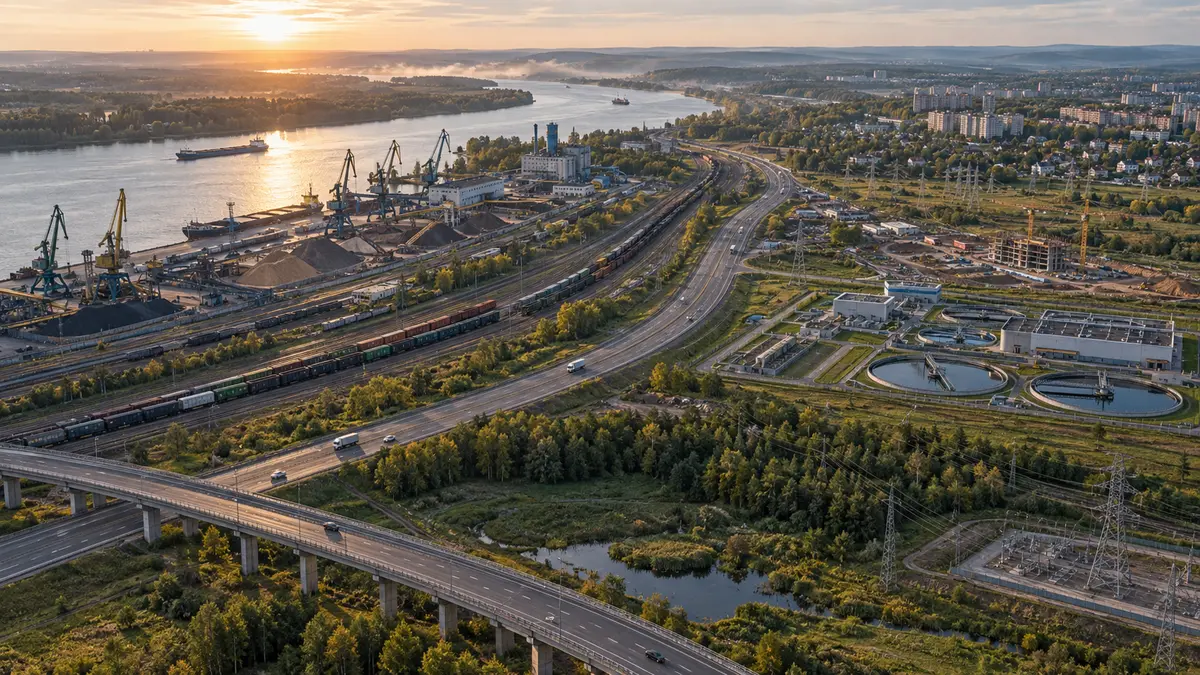
Russia’s estimated infrastructure requirement for the next decade is much larger than expected spending. Yet the missing trillions are not simply an empty space that private investors can fill. Capital reaches projects only after demand, engineering, permissions, revenue and risk have been made credible. The financing gap therefore begins long before a lender sees an application.
Infrastructure debates often start with an enormous number. Roads, railways, power systems, water networks, digital facilities, schools and tourism assets are added into a ten-year requirement. Expected public spending is deducted, and the remainder is described as an opportunity for private capital. The arithmetic is useful, but it can imply that money is the only scarce resource. In practice, investors also need a pipeline of projects ready to absorb money on acceptable terms.
That distinction frames a June 2024 Interfax Russia report from the Dvizhenie forum in Sochi. Alexander Aksakov, director of the Infrastructure Bonds division at DOM.RF, estimated that Russia could require up to RUB 30tn of infrastructure investment over ten years, while expected expenditure was RUB 18tn–20tn. The uncovered need was placed at about 35%. He also said private infrastructure investment had more than doubled in recent years and that major projects could create up to 400,000 jobs and improve life for 70m–80m people.
A national percentage contains thousands of local decisions
The 35% estimate expresses scale, not a financing programme. It does not specify which projects are essential, which already have sponsors, which will generate cash and which must remain publicly funded. It says nothing about timing. A bridge needed in year two cannot be replaced by a data facility completed in year nine, even if their investment values are identical. An aggregate gap therefore cannot be allocated simply by choosing the highest-return projects.
Every asset sits inside a local system. A logistics terminal depends on access roads, rail paths, power, customs processes and land planning. Housing needs water, schools and transport before it produces a functioning district. A tourism complex requires utilities that may serve nearby communities as well as visitors. The financial model for the headline asset can look attractive while the surrounding enabling works have no direct revenue source.
The first task is to decompose the national need into service outcomes. Which freight corridor needs more reliable capacity? Where is untreated water constraining housing? Which settlement faces costly power interruptions? What digital capacity allows businesses and public services to operate? Once the outcome is defined, planners can compare expansion, repair, demand management and operational improvement rather than assuming that a new structure is always the answer.
The gap between need and a bankable project
A community can have an obvious need without having an investable project. Bankability requires a legally capable sponsor, defined scope, engineering evidence, land rights, permissions, procurement strategy, reliable cost estimates and a credible source of repayment. Weakness in any one element increases contingency, shortens lender appetite or stops the project entirely.
This preparation gap is often hidden because it produces no dramatic construction site. Feasibility work, surveys, legal agreements and demand studies appear as administrative expenditure. Yet they determine whether billions can be deployed later. Cutting early preparation to save a small percentage of total cost can leave far more capital unused or expose construction to expensive redesign.
- Service case: define the measurable capacity, reliability or access problem the asset will solve.
- Demand case: identify users, volumes and realistic willingness or ability to pay.
- Technical case: test engineering options, interfaces, climate exposure and lifecycle maintenance.
- Legal case: secure land, permissions, sponsor powers and enforceable contracts.
- Commercial case: choose procurement and risk allocation that suppliers can price competitively.
- Financial case: show revenue, public payments, reserves and downside coverage over the asset’s life.
Not every infrastructure asset should carry private finance
Private capital is neither free money nor a test of policy sophistication. Pension funds, banks and specialist investors require a return for construction, demand, operating, inflation, currency and political risk. Government can sometimes carry those risks more cheaply. The relevant question is whether private participation improves lifecycle discipline, delivery capacity or risk management enough to justify its financing and transaction costs.
Assets with measurable use and dependable payment streams are easier to finance. Freight terminals, utility connections, data facilities and some tourism projects can charge customers. Social infrastructure may rely on long-term availability payments from a public authority. Roads in low-income or sparsely populated areas can be essential without producing sufficient toll revenue. Trying to force each asset into the same structure distorts both tariffs and project selection.
Public and private roles can be divided within one system. Government may fund land, access roads or a minimum service, while an operator finances revenue-producing facilities. A public entity can retain demand risk and transfer construction and availability risk. Another project may keep operations public but issue bonds against a transparent budget payment. The structure should follow the risks, not an ideological label.
Risk transfer works only when the recipient can manage the risk
A contract can assign almost any risk on paper. Economic risk remains with the party best able—or ultimately forced—to absorb it. If a contractor cannot control a late land handover, pricing that risk raises bids without preventing delay. If a municipality guarantees demand it cannot forecast, the liability returns to the budget when usage disappoints. If tariffs are politically impossible, a model built on automatic increases will fail regardless of legal wording.
Good allocation links control, information and financial capacity. Designers and builders can manage errors within their scope. Operators can manage maintenance and service quality. Government controls many approvals and can coordinate public interfaces. Demand may be shared through minimum-revenue mechanisms, phased capacity or payments linked to availability rather than volume. Exceptional risks need explicit treatment instead of being buried in a general transfer clause.
Transparency is particularly important where public support improves investor returns. A subsidy, guarantee or infrastructure bond programme can unlock a project with broad economic benefits. It can also hide an unpriced liability. Decision-makers should publish the reason for support, its maximum exposure, the conditions for payment and the service obtained in return. Contingent obligations belong beside direct debt in long-term affordability analysis.
The project pipeline needs stages, not a wish list
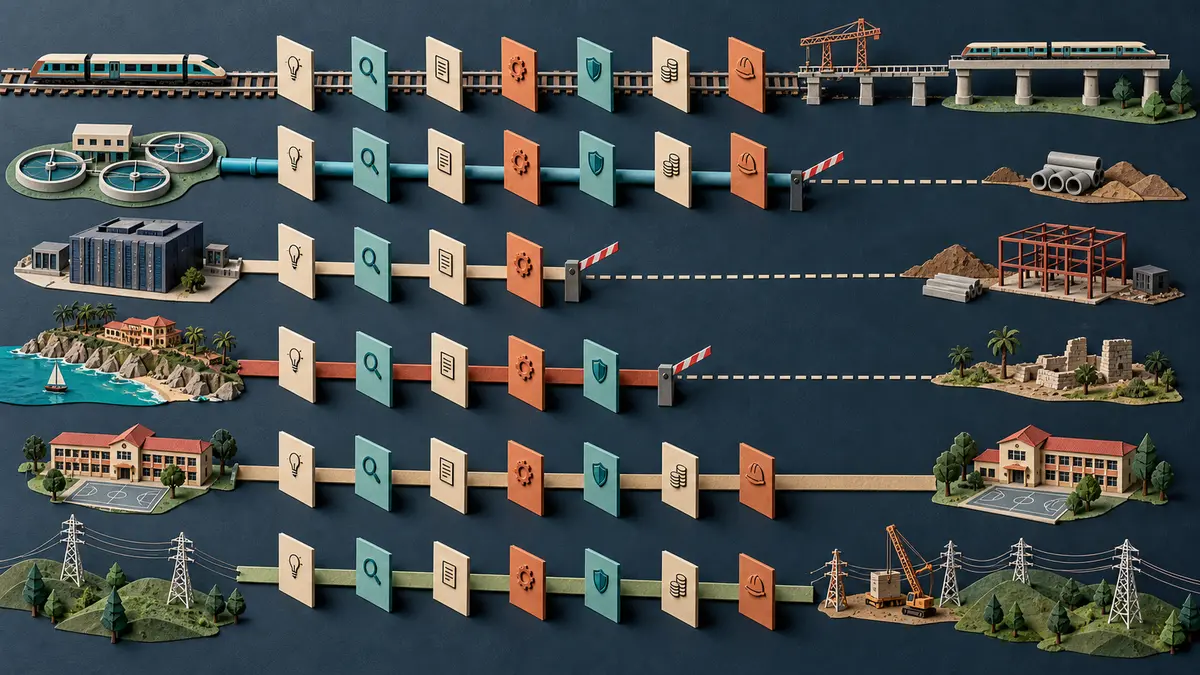
Many infrastructure plans combine mature procurements with ideas that have no sponsor or engineering. Adding their capital values creates an impressive pipeline but gives investors little guidance. A staged register should separate concepts, projects in feasibility, permitted projects, procurements, financed transactions, construction and operating assets. Movement between stages should require evidence.
A clear pipeline helps government direct scarce preparation funds. It helps contractors plan staff and equipment. Lenders can engage before procurement and explain which terms prevent financing. Communities see when a proposal remains uncertain. Most importantly, projects that fail a gate can be redesigned or removed before sunk political commitment makes cancellation difficult.
- Define the service deficit and test lower-cost operational alternatives.
- Assign an accountable sponsor with authority, staff and a preparation budget.
- Complete demand, land, environmental and preliminary engineering evidence.
- Select the delivery model only after risks and revenue have been mapped.
- Run market sounding without promising terms to a preferred participant.
- Obtain approvals and publish the fiscal exposure before procurement.
- Track construction, commissioning and operating outcomes against the original service case.
This discipline reduces a familiar problem: projects are announced before interfaces are understood, then redesigned during procurement or construction. The resulting delay is blamed on the investor or contractor even when the original scope was not ready. A gate system makes readiness visible and protects serious projects from being crowded out by politically attractive concepts.
Transport and logistics require corridor economics
The Interfax report identified transport and logistics as the largest area of future need, reflecting new eastern trade routes and supply chains. A corridor is not one piece of concrete. Its performance is determined by the slowest border, terminal, bridge, rail section, warehouse or data exchange. Expanding one component can move congestion downstream rather than increase end-to-end throughput.
Investment appraisal should therefore measure corridor outcomes: travel time, reliability, capacity during peaks, cargo damage, transshipment cost and access for regional producers. Projects can then be sequenced around binding constraints. Digital scheduling or a redesigned junction may produce more value before an entirely new terminal. Maintenance of an existing route can outperform expansion if deterioration is the real cause of unreliability.
Corridor benefits also cross administrative borders. One region may pay for access that produces tax revenue in another. A port can depend on rail improvements far inland. Without a mechanism to share costs and benefits, each authority underinvests in interfaces. National coordination is valuable here, but local evidence remains essential because land, communities, labour and utility conditions determine delivery.
Tourism and digital projects need different safeguards
Aksakov described tourism and digital technology as sectors relatively open to private investment. Both can generate revenue, yet their risk profiles differ. Tourism demand is seasonal and exposed to transport, household income and destination reputation. Infrastructure can be overbuilt around optimistic visitor forecasts. Phased capacity, diversified uses and transparent public-service obligations reduce the danger of an enclave that operates below plan.
Digital infrastructure faces faster technological change. A facility with strong demand today can encounter new equipment density, energy requirements or network architecture. Contracts need upgrade paths and clear rules for obsolete assets. Power availability, cooling water, fibre diversity and cybersecurity are operating constraints, not secondary details. A local authority offering land should understand whether the project creates broad connectivity or only a closed facility.
In both sectors, public support should purchase spillovers that markets will not deliver alone. Tourism access can also serve residents. Fibre built for a data facility can improve local redundancy if access is planned. Training commitments can deepen the labour market. These benefits need measurable conditions; otherwise they remain promotional claims attached to private assets.
Jobs and quality of life must survive the construction phase
The estimate of up to 400,000 jobs and benefits for 70m–80m people expresses the potential reach of the programme. It should not be treated as an automatic multiplier. Construction creates temporary work, while operation may require fewer but more specialized roles. Imported equipment and external contractors can limit local capture. Poorly planned projects can also displace homes, increase tariffs or impose maintenance obligations that outlast initial investment.
A credible jobs case separates construction, supply-chain and permanent employment. It states skill requirements, recruitment geography and training timing. A quality-of-life case identifies service reliability, travel time, affordability, environmental effects and access across income groups. Baselines must be recorded before construction so that outcomes can be measured rather than inferred from expenditure.
Maintenance deserves equal status with opening. A new asset that lacks funded inspection, replacement and operating staff gradually converts capital into a liability. Lifecycle budgeting should reserve money for predictable renewal and report condition publicly. Private contracts can enforce maintenance only if performance is measurable and the public counterparty monitors it.
Closing the gap starts with better evidence
The difference between RUB 30tn of need and RUB 18tn–20tn of expected expenditure is too large for one financing instrument. It will require prioritization, public budgets, infrastructure bonds, bank lending, user revenue, corporate investment and projects that are redesigned or deferred. The objective should not be to make the 35% disappear on paper. It should be to fund the highest-value services without creating unaffordable tariffs or hidden public liabilities.
A national dashboard can track the value and number of projects at each readiness stage, average preparation time, procurement competition, financing source, cost variation, commissioning and service outcomes. Regional dashboards should expose interfaces and maintenance condition. Independent review should challenge demand and affordability before political commitment hardens.
Capital interest in infrastructure is real, and risk-sharing tools can expand it. But investors cannot finance an aggregate shortage. They finance contracts attached to prepared assets with credible sponsors and cash flows. The most productive response to the headline gap is therefore a stronger preparation system: fewer wish-list projects, clearer service priorities, honest risk allocation and a pipeline that repeatedly moves sound proposals into operation.
Leave a comment