
Briefings / Infrastructure
When a Small Production Unit Runs Out of Working Space
Flat components, unfinished work and completed stands compete for room. A fictional display assembler shows why choosing premises starts with the ordinary working day.
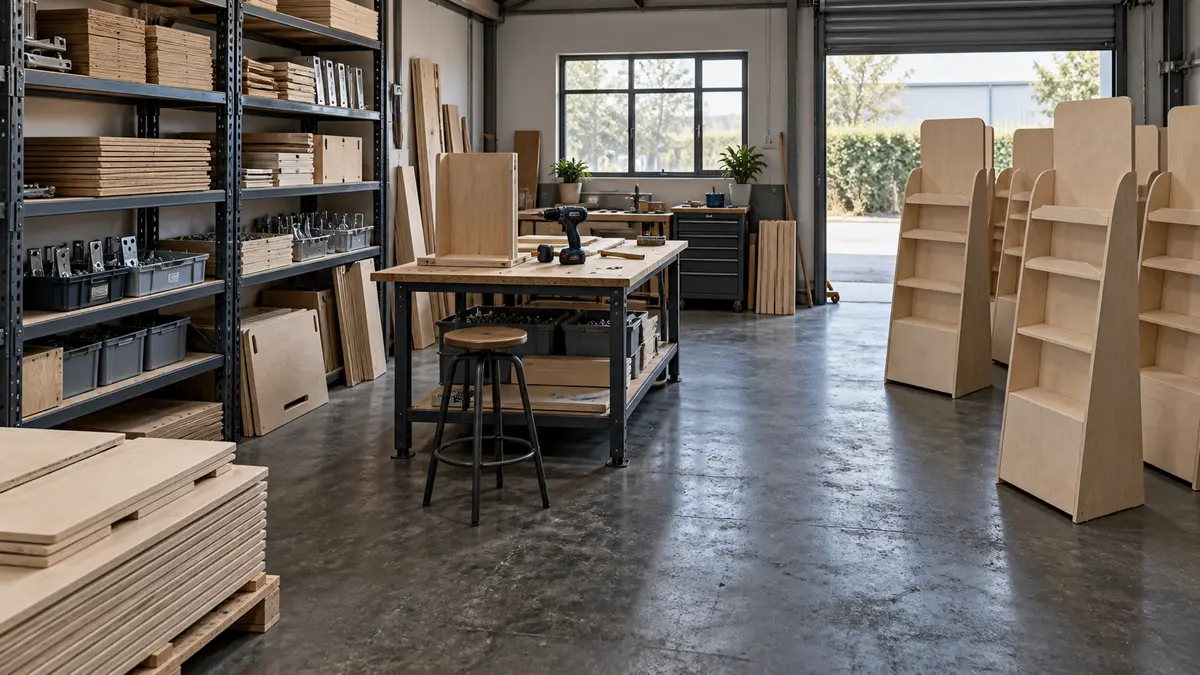
A small production business can run out of working space long before equipment occupies every square metre. Components wait for their turn, finished products wait for collection, and unfinished work waits for a customer's answer. A patch of floor that appears free may already be needed for several tasks. A useful conversation about new premises therefore begins not only with total floor area, but with how the business uses it throughout an ordinary working day.
In an article published by BFM.ru on 9 April 2025, Valeria Mozganova examined interest in small production and storage properties in Russia's capital region. Interviewees discussed combining functions and adapting premises to their users. Expectations of further market growth in the report remained forecasts, not results from a completed year.
Behind the discussion of a property format lies a practical question for an occupier: will its work fit inside the proposed unit? The example below is a fictional company assembling retail display stands from ready-made components. It does not describe an actual industrial-park tenant. It follows materials and orders through the business without proposing an engineering layout, safety standards or lease terms.
One address does not make the work fit together
The imagined company has somewhere for components, manual assembly benches, a place to check a completed stand and packaging before collection. Staff also need to discuss orders and clarify incoming deliveries. Bringing everything to one address sounds attractive: the separate functions need not be imagined as separate businesses. Proximity, however, does not explain how they will coexist. An incoming batch and a completed order may both need the same temporarily vacant space.
That conflict is easy to miss when viewing an empty unit. The owner mentally positions an assembly bench, puts materials beside it and imagines finished products near the exit. Each part fits when considered independently. The question appears when they are imagined together: the previous order has not been collected, the next delivery has arrived, and the current job cannot simply be taken off the bench. Useful space depends not only on the size of objects, but on how long they remain present.
The description of future premises should therefore relate to what the company does. “We need assembly and storage” leaves too much unexplained. A more informative account describes what arrives, in what condition, how many stages it passes through before collection and where work pauses. That conversation does not replace a professional assessment of the property. It helps establish the subject of that assessment: a particular combination of activities and movements, rather than an abstract production business.
Materials occupy space before assembly begins
In the fictional example, a supplier delivers finished panels and fittings. Before using them, the company needs to understand what it has received and which order the items belong to. Even when the operations are straightforward, arrival does not instantly become assembly. Materials spend some time between delivery and use. If the owner's picture includes only permanent stock and completed products, that intermediate stage has no place of its own in the description.
One delivery may contain components for several stands. Their presence in the unit does not establish that any order can begin. One set is complete, another lacks a part, and a third awaits clarification. The packages may look alike to a staff member, but their next steps differ. Recognising those differences helps explain why some occupied space does not support current work, even though the materials have already been paid for and delivered.
Moving to a larger unit will not automatically remove that uncertainty. It may provide room to separate materials temporarily, but it will not establish which are ready to use. It is therefore useful to examine crowding alongside the reasons for waiting. Sometimes the business genuinely lacks room for its ordinary workload. Sometimes a substantial area holds items awaiting a decision. Both situations can exist together, and reducing them to one floor-area figure is insufficient.
A completed stand does not disappear when the work ends
For an assembler, completing an order frees attention for the next one. For the premises, the situation is different: the finished stand still exists, sometimes occupying more space than its original flat components. It needs to be checked, prepared for collection and kept until it leaves. Production completion and the release of floor space are therefore different events. Treating them as one moment can allow the next job to begin on paper before there is actually room for it.
In the imagined company, a customer postpones collection of a completed stand. That need not require a reorganisation of the entire operation, but it changes the presence of a particular object in the unit. If the order was expected to remain only until the evening and instead stays for several days, the previous picture of space use no longer holds. It is important to recognise that connection, rather than immediately interpret every postponement as poor customer behaviour or a need to expand at once.
This connection is useful when discussing a new unit. The owner can explain not only the normal size of a finished product, but the situation in which several orders await collection together. This is not a demand to design premises around every exception. It is a way to distinguish a recurring working situation from an unusual event and understand which conditions the company genuinely needs to consider when choosing another address.
Three different moments in an order's life
- Materials have arrived, but work has not begun.
- The product is being assembled or its final specification is being clarified.
- The order is ready, but remains in the unit until collection.
This list describes a fictional process, not a universal classification of production areas. Its purpose is to show how the same word, “order”, conceals different demands on space. When discussing premises, it helps to describe the state of the work, rather than only the number of customers. That makes it easier to understand why a company with relatively few simultaneous orders can nevertheless feel crowded.
An empty unit and a working day look different
A viewing reveals the property itself, but not its future life. An empty floor makes it easy to imagine an orderliness that the business will still need to maintain. A more useful exercise follows the company's ordinary day: components arriving, assembly continuing, checking, packaging and collection. The account reveals moments when several activities need the same space, although each appears minor when considered separately.
For example, a stand prepared for collection may temporarily occupy the area intended for checking the next one. If the owner recalls only the eventual positions of benches and stock, that overlap remains invisible. Following the sequence of work produces a specific question: where will the first order be while the second is checked? Answering it requires an assessment of the actual conditions, but the question itself can be formulated before the premises are chosen.
It is particularly important not to present this everyday account as a technical design. Passage dimensions, permitted loads, building systems and requirements for the activity need competent assessment for the particular property. The owner's description serves another purpose: it helps specialists and the party offering the unit understand what will actually happen there. The more precisely the work is explained, the less reason there is to replace it with a general promise that the property format is flexible.
Collection connects the unit to an outside timetable
A completed product does not leave simply because the assembler wants it to. The order's readiness, collection arrangements and an available movement must coincide. In the fictional company, the person collecting a stand might arrive during the same period as components for the next job. That does not prove a defect in the premises. It shows how the internal working day connects to events outside it. Waiting space and communication about timing become parts of the same business question.
Nor can the business assume that every schedule change is entirely within its control. A customer may report a postponement late; a delivery may arrive differently from expectations. The owner is assessing the ordinary variability of the work, not an ideal day without deviations. Explaining which overlaps occur regularly and what consequences they have is useful. Such detail helps establish whether an address fits, without promising to eliminate every uncertainty.
For the display-assembly company, this is also a reason to distinguish production from collection in its own planning. Finishing assembly allows it to report that an order is ready, but does not confirm that the space is already free. When the team understands those as separate events, the conversation about the next batch becomes more precise. Additional space may still be necessary, but its purpose becomes explainable: somewhere for a particular part of the working cycle, not simply a vague allowance for growth.
The activity matters more than the unit's appealing description
A production-and-storage property format can accommodate different users. That does not mean every unit suits every activity equally. A company should describe its future work through materials, the sequence of tasks, the nature of the finished product and how it is collected. The conversation then concerns a specific match, rather than an assumption that belonging to a popular property segment already answers all the occupier's questions.
It is also useful to separate the unit's existing condition from possible alterations. A viewing may include discussion of future preparation or adaptation for the user. The business needs to understand what is available now, what still needs assessment and work, and what remains only an idea. Those distinctions should not disappear behind the single word “ready”. Moving depends on the actual ability to begin work, not merely the appeal of a future solution.
What to explain when discussing a property
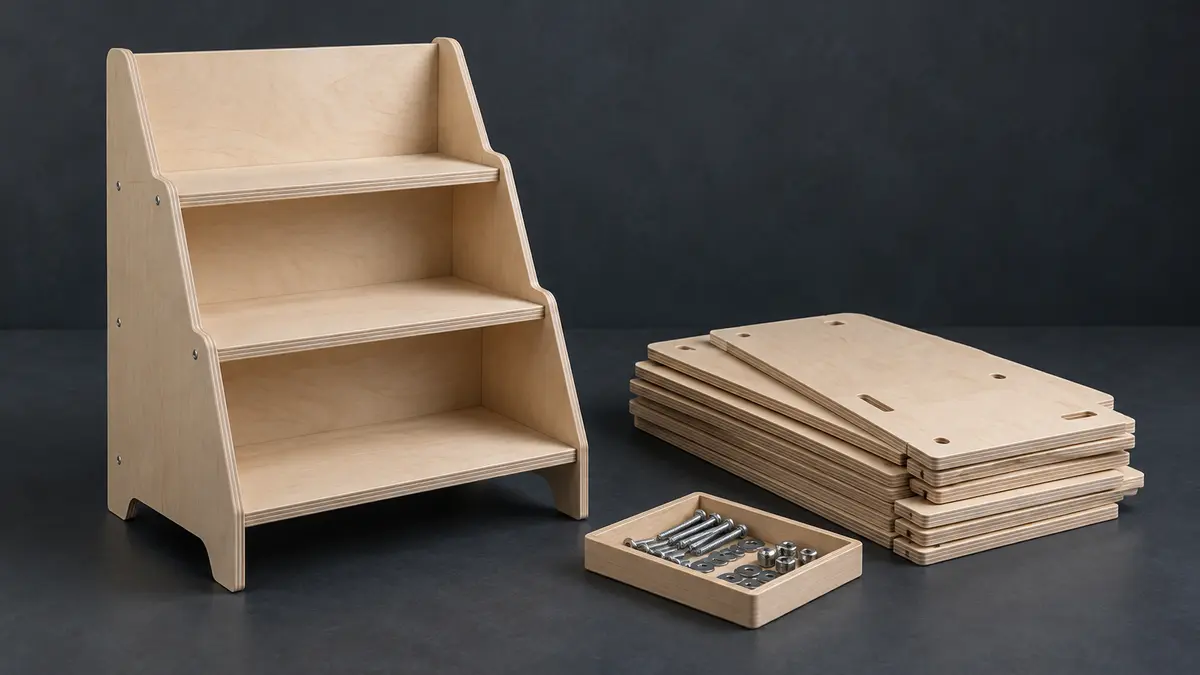
The owner of the fictional company could describe flat components arriving, manual assembly into bulky stands and the wait for collection. They could show what counts as an ordinary order and what creates a temporary overlap. This does not require inventing a precise layout before an assessment. It helps the other party understand the task and identify questions needing separate checks. A useful outcome is not necessarily immediate agreement, but a clear understanding of what is still unknown.
Moving also takes working time
New premises are usually discussed as somewhere for a stable future operation. Between the old and new addresses, however, lies a transition. Some stands in the fictional company may already be assembled, others may be in progress, and components for later orders may still be expected from a supplier. Moving the business does not turn those different states into one convenient batch. The company needs to understand which work continues and where the customer can receive the promised result.
This does not mean every small workshop necessarily needs to move in stages. The particular approach depends on its circumstances. The important point is to consider the transition, which can easily disappear from a comparison of floor area and appearance. An owner discussing only the final arrangement may overlook the temporary coexistence of old stock, unfinished orders and new arrivals. Considering the transition makes the picture less idealised, but more useful for making a decision.
Communication with customers at this point concerns understandable matters: where the order is, when it will be ready and how collection will be arranged. A description of the move need not become a promise that there will be no inconvenience. It should simply avoid treating the future readiness of the new address as an accomplished fact. The discussion of premises needs to preserve the difference between an intention to begin work and a confirmed ability to do so.
Similar floor areas can serve different combinations of orders
Even within one company, the working day changes according to what is being assembled. Several identical small stands and one large customised order may produce quite different patterns of materials in the unit. The account of the premises should therefore include the mix of work, not only the average number of orders per week. An average conceals combinations staff actually encounter. When discussing whether a unit fits, it matters whether an unusual job is exceptional or a recurring part of the business.
In the imagined example, a repeating series makes it possible to anticipate the components and assembly sequence. A customised stand may require an interim discussion with the customer about its appearance. While an answer is pending, the work remains in a particular state and continues to occupy space. That is not necessarily poor organisation: some decisions really are made after a result is viewed. But the premises need to be considered alongside that wait if it is normal for the business. Otherwise the owner will compare properties using a process that applies to only part of the order book.
It is also useful to distinguish permanent storage from an item's temporary presence. A sample retained for future discussions is not a completed order expected to leave soon. Components stocked for repeat work differ from parts put aside until a particular instruction is clarified. Calling all of these “materials” makes it difficult to explain which space becomes free naturally as work proceeds and which remains occupied for longer. When choosing new premises, that distinction helps avoid carrying old uncertainty into a larger building.
Examining the mix of orders also gives the company a more precise language for its internal conversations. The person responsible for assembly may see a problem in an unfinished product, while the person accepting enquiries sees a need to leave room for the next customer. Both describe a real part of the work, but not necessarily the same moment. Connecting those accounts into a sequence makes it easier to understand where the overlap arose. The discussion of new premises can then draw on a shared picture of the activity rather than competing impressions of who feels most crowded today.
The opportunity to expand still needs confirmation
A similar unit may sit beside the chosen premises, creating an understandable hope of growing without another move. Physical proximity does not establish availability, however. By the time the company needs more room, the neighbouring unit may be used differently. Expansion should therefore be treated as a separate question to verify, not as a piece of future space that already belongs to the business.
The fictional assembler also needs to understand what would become restrictive as it grows. More orders could mean more components waiting simultaneously, more completed stands or more work in progress. Those possibilities create different needs. If it is unclear which stage currently occupies space, a general statement about future expansion offers little help. Understanding the working cycle makes it possible to explain a future requirement, even when the exact scale and timing of growth remain unknown.
A good choice of small production premises therefore begins with observing the business itself. Total floor area remains important, but its meaning emerges through the sequence of work and the time objects remain present. For the company in this example, the useful outcome would not simply be a larger unit. It would be space whose suitability for the actual activity has been checked. That is the difference between an appealing property description and somewhere the business can fulfil its orders.
Leave a comment