
Briefings / Public Finance
From a digital budget proposal to working public services
Russia’s proposed Data Economy budget connects systems, information exchange, research and skills; allocations remain distinct from service outcomes.

A digital budget becomes publicly useful when a person can complete a necessary task without submitting the same information repeatedly or making an unnecessary visit. A large allocation alone does not demonstrate that result. Russia’s proposed financing for its Data Economy and Digital Transformation of the State national project offers a way to examine the difference. Government systems, information exchange, cybersecurity, research and skills appear together, but their ability to work as a coherent service remains a separate question.
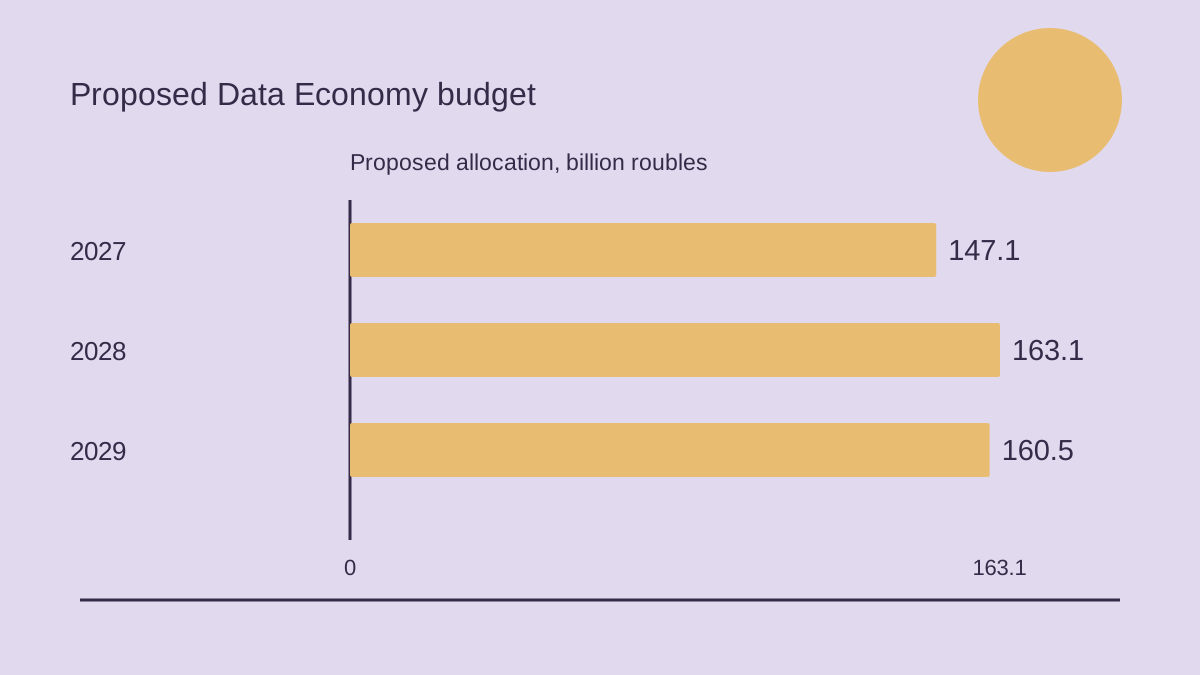
Interfax reported on 2 October that the explanatory note to Russia’s draft budget provides 147.1 billion roubles for the national project in 2027, 163.1 billion in 2028 and 160.5 billion in 2029. These are proposed allocations rather than money already spent. The organisational implications discussed below are analysis of the proposal’s structure, not reported achievements of the digitalisation programme.
A yearly allocation and a functioning service measure different things
The proposed amount rises in 2028 relative to 2027 and then declines slightly. That pattern cannot directly establish the path of public-service quality. Expenditure can support infrastructure construction, software development, maintenance or training. Each activity turns into a result on its own timetable. A completed software module still needs deployment, testing and integration into a working process. An existing system can, conversely, provide considerable value through maintenance without presenting a conspicuous new interface.
Even approved financing would be only one stage in a longer sequence. Procurement, contract delivery, acceptance and actual operation would follow. This article does not establish the status of those subsequent stages because its source describes a budget proposal. Keeping a separate measure for each stage would help assess the programme. An implementation delay would then remain distinguishable from an absence of all work, and payment under a contract would not automatically become evidence of a completed service improvement.
The distinction also matters in the regions. A resident encounters a particular certificate, application or record change rather than a federal spending total. If an interface becomes easier to use while information still requires manual checking elsewhere, the time saving may remain limited. Understanding the result requires connecting the individual user process with the systems and organisations on which it depends. That approach can reveal the relevant evidence without declaring the entire programme successful or unsuccessful in advance.
Development, operation and information exchange are connected
The largest part of the proposal concerns the Digital Public Administration federal project: 85.3 billion roubles in 2027, 86.8 billion in 2028 and 84.1 billion in 2029. Within it, Interfax identifies the creation, development and operation of information systems alongside infrastructure connecting those systems. These are nested spending items. Adding them to the federal project’s total as independent extra budgets would artificially inflate the amount by counting the same financing more than once.
Application development and data exchange address different tasks. The first creates a function used by an agency or resident. The second allows one system to receive necessary information from another. An attractive screen cannot eliminate repeated document requests if the connection does not work. Conversely, faster exchange without clear responsibility for accuracy can distribute an error more efficiently. Organisational value arises when the function, the authoritative information source and the correction procedure are coordinated.
This analysis does not assume that all these problems already exist in the named systems. They are criteria for assessing future results. The budget proposal identifies financing directions but does not publish delay, failure or data-quality measures for every service. An analyst should therefore distinguish a possible mechanism of improvement from an improvement already demonstrated. The combination of expenditure on systems and their connections creates useful questions, but it cannot supply the answers on its own.
A common platform needs clear ownership of change
The source describes plans for standard information systems on a common platform serving regional and local authorities. A shared technical approach can potentially make solutions easier to reuse. Identical software does not, however, make every administrative process identical. Services may have different source records, review periods and participants. A standard solution’s value lies in controlled repetition rather than a promise that configuration, migration and staff training will no longer be necessary.
Ownership of changes becomes particularly important. When several services use one platform, someone must have authority to alter a function, approve its effects on neighbouring processes and take responsibility for a fault after an update. If those roles remain unclear, technical commonality can spread a malfunction as readily as an improvement. A shared infrastructure should therefore be assessed with its change-management arrangements, rather than solely by the number of organisations connected to it.
For a local team, the practical value of a standard solution is a reduction in work that would otherwise have to be recreated. Local data checking, employee training and transition from the previous process still remain. Those activities belong in the plan even when the software module itself is ready. The source does not disclose individual migration timetables, so this article neither treats every region as connected nor assigns a date for the complete transition.
Cloud infrastructure needs a measurable workload
Interfax says the proposal includes Gosoblako infrastructure to accommodate anticipated workload growth. Computing and storage support government systems, but their usefulness depends on matching actual use. An insufficient reserve can impair availability at peak times. Excess capacity can remain underused. Without information about the workload profile, a budget line alone cannot establish which situation is more likely for a particular system or whether the resources will meet the intended operational requirement.
That profile includes ordinary days and periods of mass applications, record updates or large information transfers. The same number of users can therefore create very different technical demand. A short enquiry and a complex document-processing operation require different resources. Infrastructure evaluation should connect availability to the type of transaction and the time required to complete it. Average equipment utilisation, taken alone, does not describe the resident’s experience or reveal whether a critical operation can finish when needed.
Cybersecurity supports continuity without replacing it
The Cybersecurity Infrastructure federal project is proposed to receive 23.97 billion roubles in 2027, 22.4 billion in 2028 and 21.7 billion in 2029. Those amounts describe planned financing rather than a count of incidents prevented. Protection can involve monitoring, backup arrangements and operating procedures. Each component needs an appropriate assessment because installing a control does not, by itself, show that a team can restore a service after a failure.
The proposed backup data centre illustrates the relationship between a technical asset and an organisational outcome. Its usefulness depends on whether the required processes can switch to it, whether the stored information is current and who makes the transition decision. Checking those conditions differs from confirming the existence of a building or equipment. This article does not state that the centre has already been created: the source discusses proposed financing. The analysis concerns how its future result could be evaluated.
For a resident, continuity means being able to resume an unfinished procedure and obtain a correct application status. Restoring a server without restoring that sequence solves only part of the problem. Protection assessment should connect technical availability with preservation of the user process. That does not require publication of sensitive technical details. Clear availability and recovery measures, aligned with the actual service and an accountable operating procedure, can make the relevant result understandable.
Artificial intelligence depends on the underlying records
The Artificial Intelligence federal project is proposed to receive 8.7 billion roubles in 2027, 12.9 billion in 2028 and 13.6 billion in 2029. The source separately describes research, a data exchange and analysis platform, and student training. Growth in the proposed financing is not a measure of model accuracy or application-processing speed. Those outcomes require separate assessment after operational solutions and defined tasks exist on which their performance can be checked.
An analytical system may help identify inconsistencies or compare information, but its result depends on the underlying record. If that record is outdated or relates to a different object, faster computation does not make the conclusion correct. Data preparation therefore includes identity, provenance, updating and a way to correct errors. These conditions matter especially when an output affects the next action of a resident or agency. Here they are organisational criteria rather than claims about a particular deployment.
A clear boundary of authority is also necessary. An employee suggestion, an automated format check and a substantive decision on an application have different consequences. They cannot be evaluated through one undifferentiated count of processed requests. The budget proposal does not disclose a list of specific automated decisions, and this article does not assert that decision-making powers have already been assigned to a model. Future reporting would usefully describe the task and the responsible employee’s role alongside the technology’s volume of use.
Research is different from an available public service
The proposal includes applied research, quantum communications, processor prototypes, experimental sensors and future communications technologies. Their route to a result differs from maintenance of an existing information system. Research can demonstrate a technical possibility or identify a limitation. A prototype may work successfully in test conditions without being ready for everyday operation. Preserving these stages in reporting prevents scientific progress from becoming a claim that a finished product is already available to users.
Research financing benefits from a defined testable milestone: what must be demonstrated, under what conditions and how the result will be assessed. The subsequent move to production or deployment is a separate stage. Combining them would make a successful test look like completion of the entire programme, while the absence of an immediate public service could look like absence of useful research. Budget measures cannot resolve that distinction alone. A sequence of technical and organisational evidence is necessary.
Skills development has to connect with team responsibilities
The source reports plans to finance student programmes for leading artificial-intelligence specialists. Participation, completion and the ability to perform a workplace task are different measures. Training expenditure should not automatically become evidence that a skills shortage has been eliminated. Assessment needs to identify the capabilities developed, where they are applied and the conditions that allow a specialist to work with the necessary data and infrastructure. A course budget cannot answer all those questions.
Government digital projects rarely consist of one isolated model or application. They connect subject expertise, information quality, operation, security and user interaction. An individual specialist is therefore more useful in a team with clear responsibilities and understandable tasks for neighbouring participants. The training plan should be considered in relation to that working system. This article does not judge specific educational programmes because the source supplies no evidence about their learning outcomes or graduates’ subsequent employment.
What future reporting could make visible
- Approved allocations separately from proposed amounts and actual spending.
- System readiness separately from use in a real public service.
- Information exchange alongside record accuracy and error correction.
- Infrastructure availability alongside preservation of the user process.
- A research result separately from production deployment.
- Completed training separately from application of skills at work.
These distinctions do not require an invented universal score for digitalisation. They show which transition has been demonstrated and which remains ahead. A system might, for example, have passed contractual acceptance while still operating on a limited basis. That status has independent significance and should not disappear between a spending line and an announcement of launch. Clearer stages make it easier to connect investment with public outcomes without artificially overstating what has already been achieved.
Year-to-year comparisons need a consistent basis
The three yearly amounts can usefully appear together only with consistent units and status. Here, all three describe proposed allocations in billions of roubles. Placing actual expenditure for one year beside proposed financing for another would require a clear explanation. Otherwise, an apparent increase or reduction could reflect the selection of incomparable measures rather than the programme itself. The same principle applies when comparing the entire national project with one of its constituent federal projects.
A nominal amount also does not automatically measure the quantity of work purchased. Equipment, software-service and training costs can change, while activities can shift from development to maintenance. The source provides no comparable set of prices and physical outputs. This article therefore does not calculate a real increase in digital capabilities. Such a conclusion would require additional evidence about the work financed. The accompanying comparison shows only the published yearly budget proposals on their narrower, verifiable basis.
Finally, different years may fund different stages of one programme. A larger amount during initial deployment and a smaller maintenance allocation do not necessarily mean a decline in usefulness. The converse also applies: rising expenditure does not prove additional functionality. The year needs to be connected with the stage and with obligations that continue after launch. Until that sequence is disclosed, analysis should keep the question open rather than convert a spending pattern into a claim of technical progress.
A regional assessment begins with a completed task
For local authorities, a useful unit of outcome is a completed procedure rather than only a count of screens or connections. Assessment needs to establish how many steps a process requires, where repeat requests arise and who corrects a record. These questions connect funded technical components with the daily work of services. They also explain why an interface update does not always transform the whole service: part of the action may remain in a neighbouring system or with another organisation.
The budget proposal shows intended directions for resources, but it does not replace that assessment. Its amounts concern future years, and Interfax describes a proposal under discussion now. The next meaningful evidence would include approved conditions, executed contracts and demonstrated operating results. Until then, the accurate description is a proposed financing structure. Digital expenditure will demonstrate its public value through connected processes and the ability to complete a service, rather than through the size of a budget line alone.





Leave a comment