
Briefings / Trade
German wine sales and supply
Retail demand, production and export markets.
German wine grows within a declining market
Sales of still wine from Germany in Russia increased 7.2% in January–August 2026 to 797,010 decalitres. Kommersant reported the figures on 8 October, citing data from alcohol-market participants. Under the same assessment, total still-wine sales fell 4.4% to 39.02 million decalitres. Growth in the German category therefore accompanied a decline in the overall measure reported by the newspaper. These are retail volumes over eight months, rather than import value or harvest output.
Retail figures have specific periods and categories
Interfax’s half-year report, citing the alcohol regulator, put retail grape-wine sales at 26.4 million decalitres in January–June 2026, down 2.7% annually. Sparkling-wine sales instead increased 3.9% to 10 million decalitres. Fruit wines accounted for 895,700 decalitres and liqueur wines for 551,100, with declines in both segments. The breakdown demonstrates different movements among categories in the wine sector. It covers national retail over the first half of the year and does not separately identify German-origin sales. Its period and product groupings establish the scope of this reported observation.
The agency’s September report supplied the regulator’s eight-month figures: grape-wine retail sales reached 36.3 million decalitres, down 2.7% annually. Sparkling wines increased 4.3% to 13.7 million decalitres, while fruit and liqueur wines declined. The published grape-wine measure differs from the market participants’ still-wine assessment reported by Kommersant. The sources and category labels are different, and the reports do not establish the precise reason for the discrepancy. Both totals should therefore retain their separate attribution, rather than being averaged or presented as an identical national retail-sales series.
Production provides another view of the market
The preceding year’s production base appears in Interfax’s January report. According to the regulator, grape-wine output rose 13.6% in 2025 to 36.98 million decalitres. Sparkling-wine production reached 18.96 million decalitres, increasing 7.7%. Fruit alcoholic products amounted to 1.9 million decalitres, against 5.9 million in 2024. This breakdown concerns manufacturing rather than purchases by final consumers. Annual output supplies its own context for subsequent interim figures because it covers a complete calendar year and distinct product groups within the regulator’s reporting. It remains separate from the retail origin-specific assessment.
For the first half of 2026, the regulator reported production of 15.4 million decalitres of grape wine, down 12.6% annually. Sparkling-wine output fell 14% to 6.2 million decalitres, and liqueur wines dropped 31.6% to 441,100. The agency published these results in July. They describe manufacturing in the first half, alongside a separate release covering sales during that period. The comparison preserves two independent observations of the industry. It does not turn the difference between production and retail volumes into a complete calculation of inventory movement, which the releases themselves do not provide.
The next production report covered January–August. Grape-wine output reached 20.4 million decalitres, falling 14.8% against the corresponding period of 2025. Sparkling-wine production was 8.9 million decalitres, down 14.6%. Liqueur wines amounted to 482,800 decalitres and fruit wines to 621,400, both declining. The eight-month period matches the duration of the principal retail assessment but measures a different activity. Domestic manufacturing and sales in shops have separate coverage. This release therefore adds evidence about production without directly establishing the volume of German wine supplied to customers during the same reporting window.
Nine-month results published on 8 October showed the production decline slowing. Grape-wine output reached 24.6 million decalitres, down 8% annually. Sparkling wines amounted to 11.5 million decalitres, decreasing 5.6%. Liqueur wines totalled 563,700 decalitres and fruit wines 804,300. The nine-month annual comparison differs from the eight-month result in both its reporting period and preceding-year base. It provides a later observation of manufacturing. An improved annual output rate does not automatically establish an equivalent movement in retail demand, which requires its own sales measure for the relevant product categories and period.
Vineyard area and production in Germany
Germany’s Federal Statistical Office published its 2025 planted wine-grape area figures in February. Total area was 101,965 hectares. Rhineland-Palatinate accounted for 64,694 hectares and Baden-Württemberg for 25,822. A separate breakdown by wine-growing region recorded 27,657 hectares in Rheinhessen, 23,640 in Pfalz and 8,287 in Mosel. Federal states and wine-growing regions are different geographical classifications. The areas describe where vineyards are planted and their production potential. They do not themselves establish the volume of wine actually made or exported during the year, which belongs to separate production and trade statistics.
The March 2025 release put German wine and must production for 2024 at 7.75 million hectolitres. Output was 9.8% below the preceding year and 12% below the average for 2018–2023. White wine and must contributed 69.4%, with red, including rosé, accounting for 30.6%. Rheinhessen and Pfalz together represented 54.5% of production. The office described adverse weather and the presence of commercial cellars in Mosel that process grapes from other regions. Consequently, a geographical manufacturing breakdown does not necessarily match the growing location of every batch of grapes processed there.
In March 2026, the office reported wine and must output of 7.55 million hectolitres for 2025, a fall of 2.6%. The result was 10% below the six-year average for 2019–2024. White wine and must accounted for 69.6%, and red including rosé for 30.4%. Rheinhessen and Pfalz contributed 48.1%. The office connected harvest conditions with regional September rainfall, which increased susceptibility to rot and shortened picking time. This published result places export and retail figures against actual production in the supplying country, while retaining the historical period and units used by the statistical release.
An August announcement from the German Wine Institute described a different stage: the progress of the 2026 harvest. Main picking began unusually early, with the hot summer causing almost all varieties to ripen rapidly and together. Growers monitored sugar and acidity when deciding when to pick. Prolonged dry weather produced smaller berries and expectations of below-average yields. This was an assessment issued before the season ended. It describes operating conditions and the compressed picking schedule, without establishing final annual wine production or the future size of exports to individual markets.
Exports separate volume from value
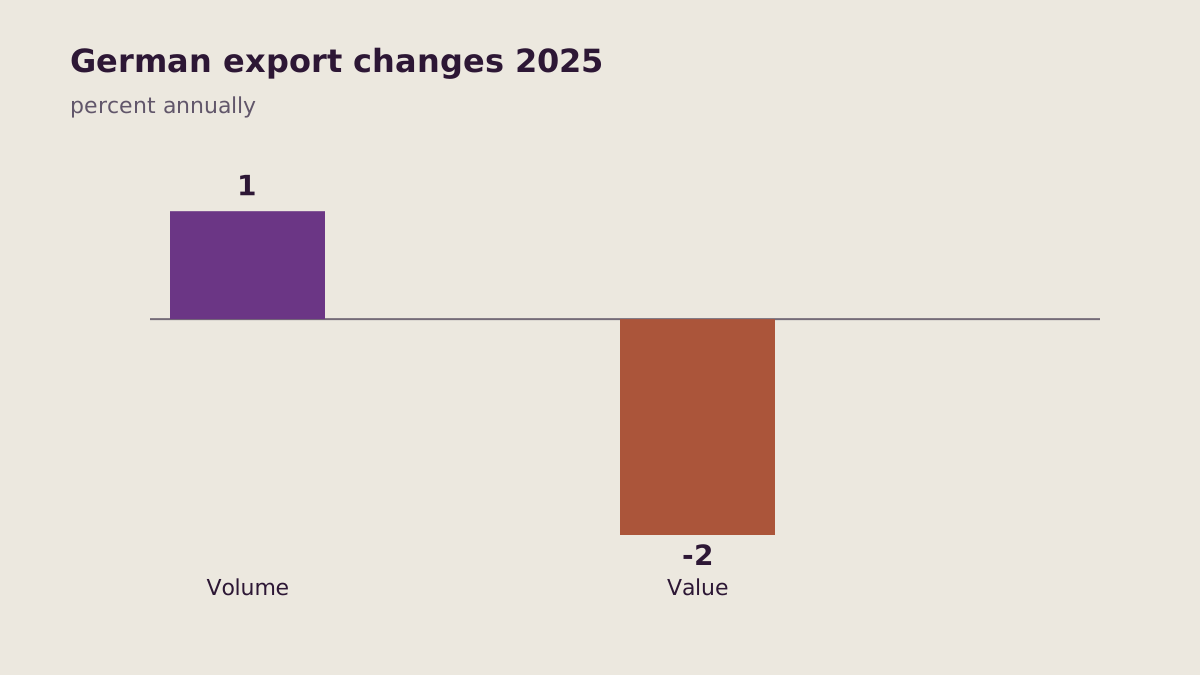
The institute’s March export review put German wine shipments in 2025 at 1.2 million hectolitres, up 1% annually. Their value nevertheless fell 2% to €377 million. Quality wines represented 71% of volume. Shipments to the United States declined 11% to 118,000 hectolitres, while value fell 19% to €51 million. The average ex-cellar price for that destination decreased €0.41 to €4.43 per litre. This annual review illustrates how quantity and money can move differently in external trade. The price concerns exports.
The institute’s April report described professional promotion in Poland. Thirty-four producers and importers presented more than 250 wines and sparkling wines from ten growing regions. Around 200 importers, restaurant representatives and journalists attended, with a masterclass accompanying the presentation. A chamber-of-commerce evening brought together 150 company representatives. This is a concrete account of engagement with professional buyers and partners. The participant and product counts describe the scale of the event. Retail sales subsequently achieved or export revenue generated would require different measures, neither of which was established by the presentation figures.
In China, the institute’s summer campaign ended on 31 August. Its September report described participation by 181 restaurants and wine bars in 41 cities, together with more than 70 retail and ecommerce partners. Promotion with METRO covered 96 shops and 34 German wines. Events in Guangzhou and Hangzhou brought importers and their assortments to visitors. The campaign combined restaurant, store and digital channels. These observations describe promotional reach in another market. They do not establish a causal connection with growth in Russia or represent a count of bottles sold through the participating businesses.
A June institute report reviewed a four-day delegation visit to Japan and China. Ministers signed a protocol declaration concerning expansion of German red-wine exports to Japan. The institute described the established association of German wine with Riesling and other white varieties, presenting red wine as an additional opportunity. In China, discussion included exchanges between younger winemakers. The publication records institutional work on export relationships. The declaration and proposed exchange concern intentions and engagement between the parties, rather than a recorded increase in deliveries, which would require separate trade figures to establish.
The institute’s July report on a competition in South Korea included a market overview. It cited imports of 52 million litres and a market value of $462 million for 2024. German wines were estimated to have around a 1% share. Category figures included 53% red, 22% white and 20% sparkling wine. An award to a particular German Pinot Noir was a result within that competition, rather than a universal ranking of all wines. The example combines professional recognition with market structure, retaining the distinction between historical estimates and the competition held in 2026.
Preparations for Wine Paris described another export-facing activity. The institute’s February announcement envisaged 66 exhibitors from eight growing regions at the joint German stand for the fair on 9–11 February 2026, compared with 51 a year earlier. The offering included Riesling, Pinot Noir, white Pinot varieties, sparkling and alcohol-free wines, alongside expert seminars. This was the announced participation and programme. It identifies the assortment and organisation of professional presentation abroad, without supplying a record of contracts actually signed or revenue generated by exhibitors during the event. Those outcomes would need separate evidence.
Domestic demand uses its own channels
The institute’s historical review published in March 2024 drew on the NielsenIQ household panel for wine purchases in 2023. Online channels accounted for 13% of all purchases and food retailers for 64%, including 37% through discounters and 27% through supermarkets. For German wines specifically, 24% were purchased from producers or their online shops. That last percentage has a different denominator: German wines alone. The review distinguishes general wine retail from direct local-producer sales. Its figures describe 2023 and do not establish the current shares of those channels in 2026.
A January release from the statistical office compared retail alcohol price levels in October 2025. Germany’s level was 14% below the European Union average, and Italy’s was 19% below. Finland exceeded the average by 110% and Denmark by 23%. The comparison concerns the stated group of alcoholic beverages rather than wine alone. It describes levels between countries during one period, in contrast to annual inflation rates. Consequently, this background cannot directly become an estimate of the price of German wine in Russian shops or the change in that particular price.
Another statistical release, issued in June 2026, described household spending from the 2023 survey. Average monthly beverage expenditure was around €75: 55% went on non-alcoholic drinks and 45% on alcoholic drinks. Wine, including alcohol-free wine, and wine-based drinks represented 20% of all beverage expenditure; beer, including alcohol-free beer, represented 16%. These are averages across households of different sizes and incomes. They describe a historical money budget rather than litres consumed or expenditure solely among households buying wine. The inclusion of alcohol-free products also defines the scope of the wine-spending category.
In March, the institute presented a new domestic communication campaign aimed at recovering German wines’ market share. Plans combined shops, specialist retail, restaurants, social media and geographical targeting. Activities were scheduled from May in selected western, northern and eastern cities, as well as Munich. The institute sought to address younger and more experienced customers by connecting products with different occasions. This describes an industry promotional strategy. The stated aim of regaining market share does not demonstrate that share had already increased or that campaign expenditure had achieved a particular financial return for participating businesses.
Companies invest in portfolios and technology
Henkell Freixenet’s annual announcement in April 2026 reported 2025 revenue of €1.25 billion excluding sparkling-wine and spirits taxes, an increase of 0.5%. Its alcohol-free portfolio grew 18% across regions. The company described different brand performances: Mionetto revenue increased 3%, Gratien Meyer 14%, while the overall Freixenet brand declined 4%. This is an international portfolio covering several types of drinks. Its measures therefore have broader coverage than German still wine. The variation among brands and categories provides another example of differing commercial outcomes within one supplier’s reported annual business.
In October, the company announced installation of Solos Technology’s aroma-recovery system at its Wiesbaden site. According to the supplier’s description, the process captures aromatic compounds after alcohol removal and puts them back into the final product. The project concerns production capabilities for dealcoholised sparkling wine. The company explained the investment through its aim of preserving the original wine’s character. This is its technological and commercial description, rather than an independent taste comparison. The release gave no investment amount or additional output figure, so the project’s scale should retain the scope actually disclosed.
A September announcement described the acquisition of 60% of Cassidy Wines in Ireland. The combined operation would retain the distributor’s established name within the group and continue using its bonded warehouse at Citywest. The local business had almost 50 years of wine-trade experience. The partners connected the transaction with a broader portfolio and distribution capability. This concerns the organisation of sales, joining international products with local supplier and customer relationships. The acquisition and continuing operating location are separate from the ambition to become a leading distributor, which remains the company’s stated objective.
Global figures distinguish output and trade
The International Organisation of Vine and Wine’s May review estimated worldwide production in 2025 at 227 million hectolitres and consumption at 208 million. Exports amounted to 94.8 million hectolitres worth €33.8 billion, declining 4.7% and 6.7%, respectively. The organisation also noted industrial uses for distillation, vinegar and other products averaging around 30 million hectolitres annually. The difference between production and consumption therefore does not itself calculate an increase in stocks. The review separates several measures of sector balance and international trade, with separate coverage:
- Production and consumption.
- Export volume and value.
- Industrial uses of wine.
The organisation’s separate October 2025 thematic report on re-exports explains distribution hubs. Wine may first be imported into one country and then sent onward, causing it to be counted again in trade statistics. The report discussed intermediary routes in Europe and Asia, including the role of Latvia and Lithuania in supplies to Russia. This is a historical account of trading structure, rather than evidence of the route taken by every current German shipment. It helps preserve the distinction between production origin, an intermediate supplier and the final market when interpreting trade and retail figures.





Leave a comment