
Briefings / Trade
Pennon’s capital plan: turning finance into better water outcomes
Pennon’s larger investment plan needs evidence of asset health, environmental improvements and customer service, alongside a clear account of funding.

Pennon’s new fundraising plan puts water infrastructure and accountability back in focus after pollution failures.
A water company can announce a larger investment programme without yet delivering a more dependable service. Money is necessary for replacing worn assets and building capacity, but its effect depends on how projects are selected, how maintenance is organised and how failures are corrected. Pennon’s October announcement therefore raises a practical question: what evidence would show that additional capital is becoming better asset health, environmental performance and customer service?
The distinction matters for communities in the United Kingdom that experience the consequences of water and wastewater failures directly. A shareholder transaction and a new pumping station operate on different timelines. A financial commitment may be made in a day, while designing, permitting, constructing and commissioning an asset takes longer. In the meantime, the existing network still needs inspection, repair and operational attention. A credible recovery plan has to connect these timescales rather than imply that funding alone settles the operational problem.
The investment plan and the financing plan describe different things
Pennon’s 7 October strategic update set expected regulated-water capital investment at about £3.6 billion over AMP8, approximately £1 billion above its original plan, in nominal prices. Chief executive Keith Haslett described an operational reset. Its funding package included a roughly £550 million rights issue, debt, reinvested efficiencies, a rebased dividend and a proposed Pennon Power sale. The company expected FY2026/27 total dividends of about £125 million versus £138 million, with an approximately 30% underlying per-share reduction after rights-issue effects and the bonus adjustment.
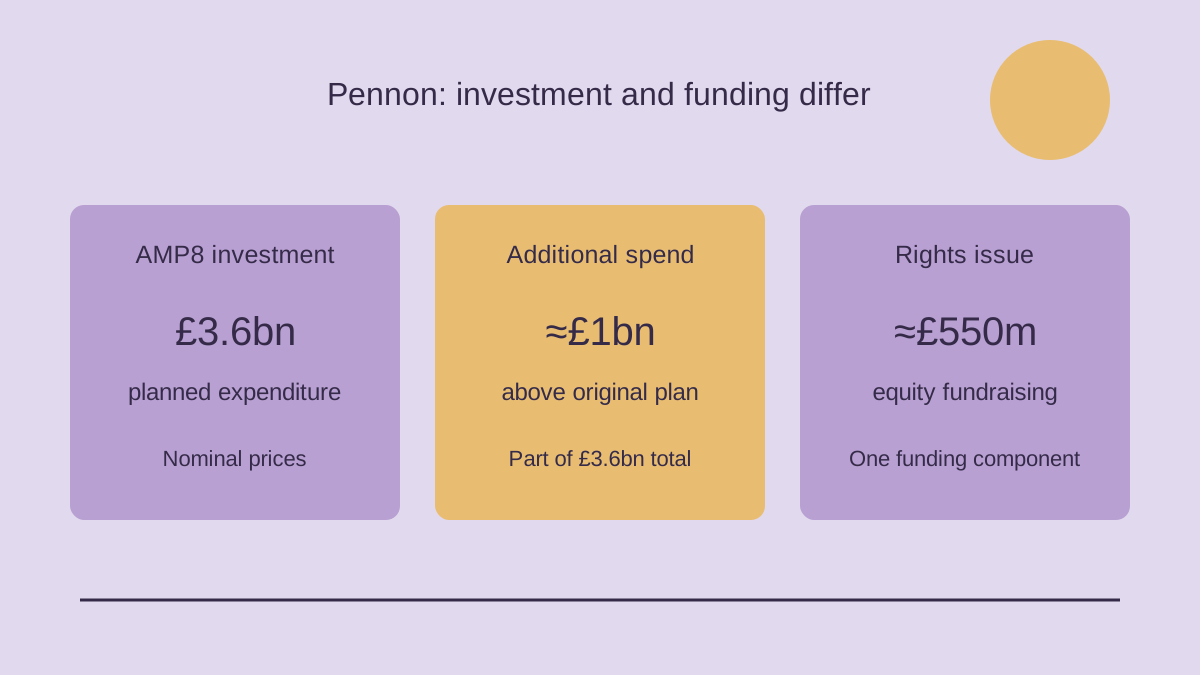
These figures need separate labels. The investment programme describes intended expenditure over a regulatory period. The rights issue is one means of financing it. It would be incorrect to add the fundraising amount to the additional investment and describe the sum as a further increase in spending. It would also be incorrect to assume that every pound of the programme will be funded through equity. The company’s announcement describes several sources of finance and retained resources working together.
The comparison between the total dividend and the dividend per share illustrates another denominator problem. A company can reduce the aggregate payment while issuing more shares, causing the amount attributable to each share to change differently. A percentage calculated from total cash payments does not answer the same question as a percentage describing an adjusted per-share comparison. Readers should preserve the company’s stated basis instead of treating the figures as contradictory or interchangeable.
Nominal prices matter because a multi-year programme can be described in different price bases. A headline amount that includes expected inflation should not be directly compared with another amount expressed in constant historical prices without adjustment. The most useful comparison uses consistent boundaries, dates and units. Here, the company’s strategic release provides the appropriate basis for discussing its enlarged programme. It does not establish that the announced expenditure has already been incurred or that every proposed regulatory treatment has been approved.
The practical implication is that a progress report needs both a financing account and a delivery account. The financing account should show which resources have been secured and on what terms. The delivery account should show which works have advanced, what they are intended to improve and whether the expected benefit is appearing. Either account alone can create a misleading impression. Cash can be available while projects are delayed; a project can progress while the overall funding plan remains exposed to changing assumptions.
Asset health is a sequence of decisions, not a spending total
An asset programme begins with information about the existing network. Managers need to understand condition, capacity, failure history and the consequences of disruption. An old asset is not automatically the most urgent replacement, and a newer asset is not automatically low risk. A relatively small component can cause a serious interruption if it sits at a critical point. Conversely, a large project can absorb substantial resources while leaving the most immediate operational weakness unresolved.
A useful prioritisation process combines the probability of failure with its likely consequences. It also considers whether maintenance, repair, operational changes or replacement offer the best response. These options have different lead times and different effects on future costs. A recovery plan should explain how the company chooses between them. An increase in capital expenditure is more persuasive when it follows a visible assessment of need than when it is presented as sufficient evidence of improvement by itself.
There is a related distinction between installation and operational readiness. Completing physical construction does not guarantee that an asset will perform as intended. Staff need workable procedures, monitoring must produce meaningful alerts and the connection to the surrounding network must function reliably. Commissioning should test the whole operating system. Otherwise, an apparently completed project can leave the organisation with equipment that is difficult to maintain or a process that fails under conditions different from the construction test.
Maintenance deserves equal attention. Capital investment can reduce the burden of recurring failures, but it does not eliminate the need for routine inspection and repair. A company that focuses only on new construction may allow existing assets to deteriorate while waiting for larger projects. A balanced plan therefore identifies measures that protect the current service during the transition. It makes clear which risks require an immediate operational response and which are addressed through longer-term replacement.
The strongest evidence connects a specific intervention to a specific problem. For example, an illustrative programme to improve pumping reliability would define the failures it addresses, establish an earlier baseline and track the relevant operating conditions after completion. It would not simply report that a project has spent its budget. This is a proposed evaluation method rather than a claim about a particular Pennon site. Its value is that it makes the intended benefit open to examination.
The enforcement record points to management as well as equipment
The Environment Agency’s 29 September account reported a £7,867,733 fine for South West Water, plus £329,993 costs and a £120 surcharge. The company had pleaded guilty to 18 charges concerning offences from January 2015 to July 2021. District Judge Matson found reckless failures in management systems and responses to known risks. The agency described repeated illegal discharges at sites in Devon and Cornwall. These are findings about historical offences, not a measurement of current network-wide performance.
The management-system finding is important to the interpretation of the new investment plan. Where a risk was already known, additional equipment may be only part of the solution. The organisation also needs a process that turns information into action. An alarm must be understood, assigned to someone with authority and followed by an appropriate response. If any stage fails, improving the sensor alone may produce more warnings without preventing the underlying harm.
This creates a test for accountability. A company should be able to describe who owns an unresolved asset risk, how it is ranked and what happens when a permanent repair is postponed. The relevant question is not whether every problem can be fixed immediately. Networks contain competing demands and practical constraints. The question is whether the organisation understands the risk it is carrying and makes a deliberate, reviewable decision about how to manage it until the final intervention is complete.
Repeated incidents also require investigation across functions. A maintenance team may see a component problem; a control-room team may see an alert problem; a capital programme may see a replacement opportunity. These perspectives need to meet in one account of the failure. Otherwise, each team can complete its own task while the overall risk remains. A recovery programme should reduce these gaps between responsibility, evidence and action.
It is equally important to keep historical enforcement and current outcomes separate. A fine records a legal consequence for specified conduct. It does not, by itself, prove that present performance is unchanged. A new investment announcement does not erase the historical findings. Both can be true: the organisation can have a serious enforcement record and be taking steps intended to improve. The credibility of those steps depends on subsequent evidence, rather than on choosing one narrative and excluding the other.
Customer experience needs its own measures
CCW’s 2025/26 household complaints report, published on 16 September 2026, placed South West Water and Thames Water among the poorest-performing water and sewerage companies. Its methodology compares complaint rates per 10,000 connections within company segments and combines volume with an effort measure covering escalation and complaints brought to CCW.
A connection-based measure is useful because raw complaint totals can be distorted by the size of the population served. A larger company may receive more complaints simply because it has more customers. Normalising the count helps make comparisons more meaningful, provided the reporting boundaries are consistent. It still does not explain every difference: customer mix, reporting practices and the type of service supplied can affect the result. A good assessment acknowledges those limits while using the measure for the question it is designed to answer.
The effort involved in resolving a problem matters separately from the initial service failure. A customer can accept that a repair takes time yet find repeated contacts, conflicting explanations or an unclear next step exhausting. Improving an asset may reduce the number of failures, but it will not automatically make the complaint process easier. A recovery programme should therefore address both the service delivered and the experience of obtaining a response when something goes wrong.
Communication should be specific enough to be useful. A household needs to know what the company believes the problem is, what it intends to do and when another update can be expected. An accurate statement of uncertainty can be better than an unrealistic deadline. This is particularly relevant when repair work depends on access, specialist equipment or conditions that can change. Clear communication does not substitute for a repair, but it can prevent confusion from becoming an additional avoidable burden.
Customer measures should also be interpreted over comparable periods. An improvement in one month may reflect unusual weather, a reporting change or the timing of a major incident. A longer sequence, with changes in the service explained, offers stronger evidence. The organisation should be able to connect customer outcomes to the operational interventions intended to improve them. Without that connection, a favourable number can become another isolated headline.
What would make the larger programme credible?
The first requirement is an implementation schedule that identifies meaningful milestones. These should distinguish funding, design, procurement, construction, commissioning and demonstrated operational benefit. A project can move through several stages before customers or the environment experience an improvement. Showing those stages helps readers understand progress without confusing preparatory work with a completed outcome. It also makes delays more visible and allows the company to explain their consequences.
The second requirement is a consistent account of scope. If a programme expands, the company should explain whether the change adds new work, increases the cost of existing work or shifts resources between priorities. The same spending total can reflect different combinations of these effects. A clear account preserves the original baseline and shows how the revised plan differs. It avoids presenting every increase in expenditure as an equivalent increase in useful output.
The third requirement is evidence about maintenance and response capability. A construction programme can be ambitious while everyday operational weaknesses remain. Readers should look for information about recurring faults, unresolved risks, alert handling and the speed of corrective action. These indicators help show whether the organisation is becoming more capable of managing its existing network. They are also relevant to whether the new assets can be operated effectively after completion.
The fourth requirement is honest treatment of dependencies. Regulatory decisions, planning permissions, supply capacity and contractor performance can affect delivery. A plan should show which assumptions remain unsettled and what alternatives exist if they change. That does not make the plan weaker; it makes its confidence level understandable. An unconditional claim about a programme whose important approvals remain pending would conceal the practical work still required.
- Keep the financing account separate from investment delivery.
- Report commissioning and operational benefits after construction.
- Track known asset risks and corrective responses.
- Measure customer effort as well as complaint volume.
Finally, progress should be judged by outcomes that match the stated purpose. Raising capital can support a stronger balance sheet and enable investment. Spending that capital can improve assets. Neither step alone proves fewer harmful discharges, more dependable water service or easier complaint resolution. Pennon’s announcement is a financing and operational commitment whose value will be established through delivery. The public test is whether resources, management decisions and measurable improvements begin to tell the same story.

















Leave a comment