
Culture and travel
Imam al-Bukhari’s Heritage and Samarkand’s Pilgrimage Landscape
Imam Bukhari’s scholarship, the rebuilt memorial near Samarkand, its mosque and museum, and nearby visitor accommodation.

The Imam Bukhari memorial near Samarkand is a major destination within Uzbekistan Islamic heritage and pilgrimage routes. The rebuilt complex combines a mosque, museum, research connections and nearby visitor facilities around the scholar’s tomb. Completed reconstruction was reviewed during a presidential visit on Mar 19, 2026. The new architecture and accommodation add a contemporary layer to the older memorial destination.
President Shavkat Mirziyoyev reviewed the rebuilt facilities on Mar 19, 2026. The new mosque has capacity for ten thousand people, and the museum contains nine pavilions. The memorial and the surrounding visitor area occupy separately described spaces. Different overall area figures appear in the March presidential account and April tourism coverage, with their respective scope and attribution retained below.
The rebuilt complex and its reported scale
The complex covers 63.2 hectares in the Apr 7 tourism description. The Mar 19 presidential account assigns forty-five hectares to the memorial and a separate adjacent fifteen hectares to visitor facilities. The summaries do not explain the difference in boundaries. These figures remain attributed to their respective descriptions, rather than being added together or treated as measurements of an identical area.
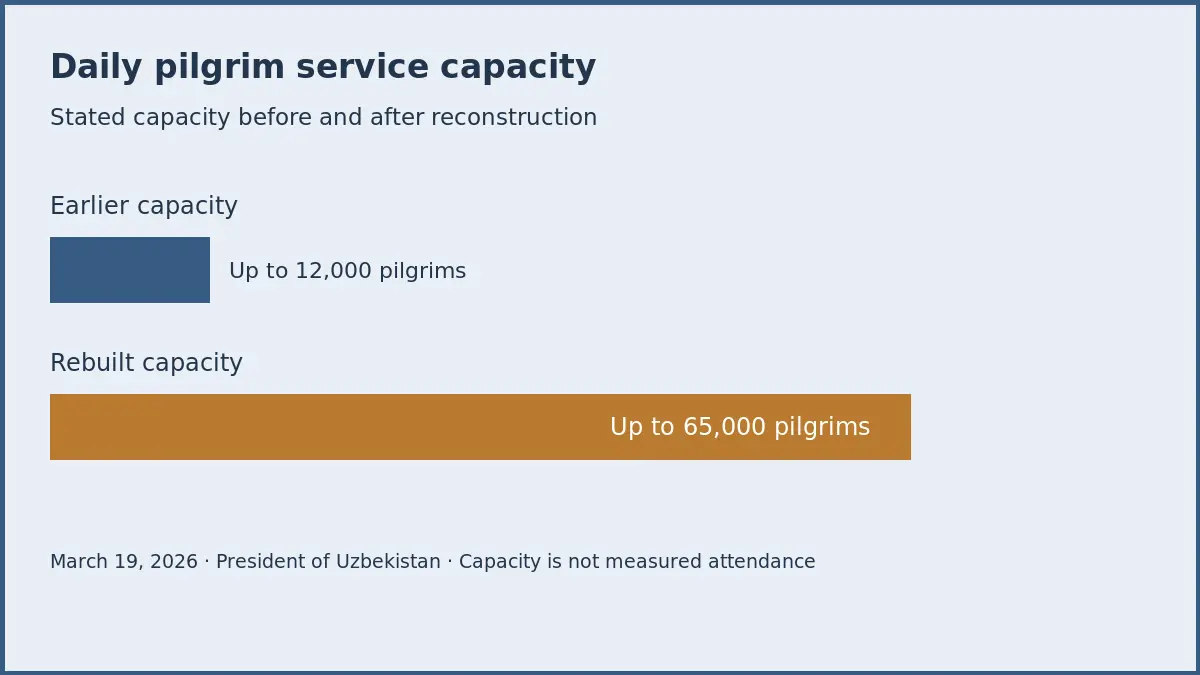
The mosque has capacity for ten thousand people. A columned aivan contains 154 columns, and the museum comprises nine pavilions. The wider facilities have a stated daily service capacity of up to 65,000 pilgrims. The mosque figure concerns the prayer building’s capacity, while the daily figure covers visitor provision over a longer interval across the memorial destination.
The rebuilt complex’s stated daily service capacity rose from up to 12,000 pilgrims to up to 65,000. The comparison describes provision before and after reconstruction, according to the presidential account. It is a capacity comparison rather than a count of actual daily attendance. The mosque, museum and adjacent visitor facilities provide different spaces within the completed reconstruction programme.
The memorial stands in Payaryk district of Samarkand region. Imam Bukhari’s tomb is located there, outside the Registan ensemble in the city. The destination has its own mosque, museum and associated facilities. A regional journey connects Samarkand with the memorial through a separate transfer, with the city’s monuments and the scholar’s burial place forming different stops.
Imam Bukhari's life and geographical connections
Imam al-Bukhari was born in Bukhara on Jul 21, 810 and died in Khartang in 870. His burial place lies near Samarkand. The name al-Bukhari identifies his association with Bukhara, while the memorial occupies the place connected with his death and burial. His biography therefore links two parts of Uzbekistan’s historical geography alongside his wider scholarly journeys.
He is known as a collector and scholar of hadith. In Islamic scholarship, hadith concern transmitted reports associated with the Prophet Muhammad's words, actions and approvals. Their study includes attention to the content of a report and to the chain through which it was transmitted. This is a different textual category from the Qur'an.
Sahih al-Bukhari is one of the six major hadith collections, with religious authority especially associated with Sunni tradition. Imam Bukhari authored more than twenty works. Hadith scholarship concerns transmitted material associated with the Prophet Muhammad, including the content of individual reports and their chains of transmission. Collections organise that material, while later editions and commentaries provide further forms of scholarly work.
A scholar's life, a collection attributed to him and a later memorial building belong to different periods. The ninth-century biography concerns the person. A manuscript or printed edition concerns a physical copy of a text. The reconstructed complex concerns a modern place of commemoration, worship and interpretation. Their connection is central to the site, but their dates should remain distinct.
Hadith collections, manuscripts and reading
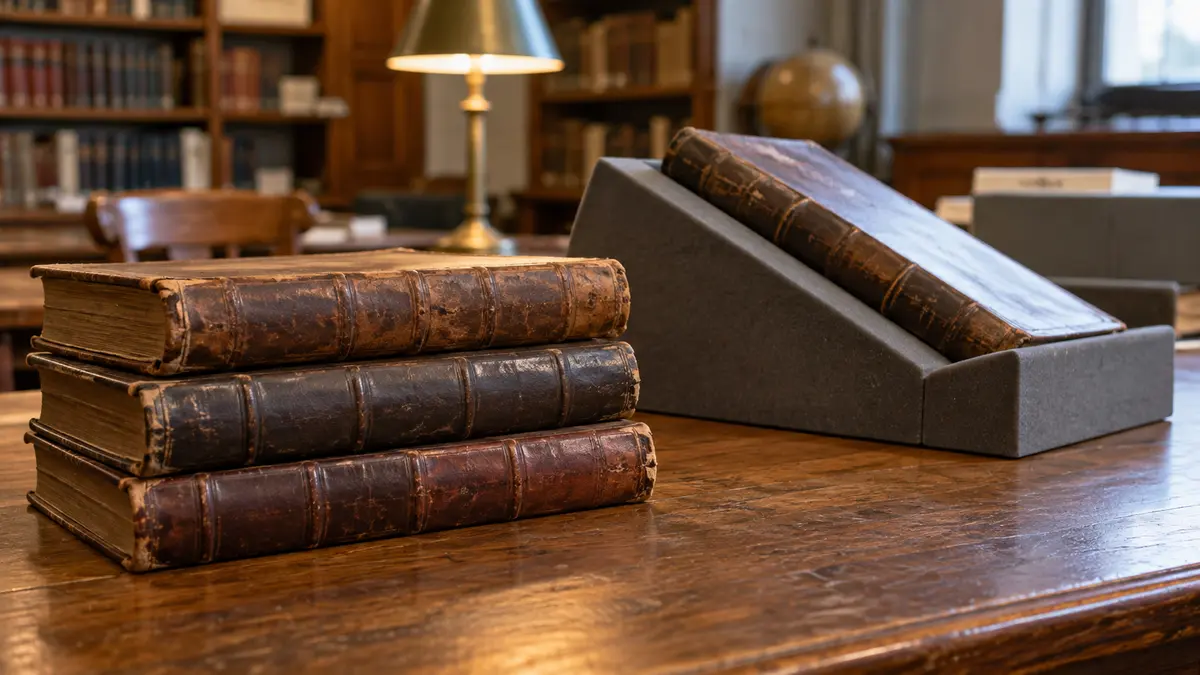
A transmitted text can exist in many copies. A manuscript is written by hand and has its own script, material, binding and history of use. A printed edition is produced through another process. A modern translation introduces an additional relationship between the original language and a reading audience. The age of a displayed copy does not automatically give the date when the underlying work was first compiled.
Hadith scholarship also uses terms that describe different kinds of work. Compilation organizes reports; commentary explains them; transmission records relationships between teachers, students and texts. A museum can present these activities through interpretation, but a short display is not equivalent to a complete scholarly study of a collection.
The museum includes the process of collecting and recording hadith within its programme. That subject sits alongside Imam Bukhari’s biography and scholarly work. Displays introduce the gathering, evaluation and organisation of transmitted material through interpretation for visitors. A text’s content, its transmission history and the physical manuscript in which it survives provide different subjects within the wider study of hadith.
A library encounter offers another form of access. Researchers may use editions, catalogues or digitized material, while rare originals are preserved under separate conditions. Viewing a manuscript in a case differs from consulting a reproduction or reading an edition. Each form supplies information appropriate to a different purpose.
Dates to keep separate at the memorial
- The scholar's ninth-century life and burial.
- The date of a particular manuscript or printed edition.
- The 1998 memorial-building programme.
- The later establishment of research institutions.
- The completion of the reconstruction reported in March 2026.
The mosque, aivan and museum programme
Fourteen blue domes and four minarets, each seventy-five metres high, form part of the rebuilt complex. Its mosque, administrative building, columned aivan and museum serve different functions. The domes and minarets belong to the architectural arrangement, while the museum pavilions introduce scholarly history. The administrative and visitor spaces provide other facilities within the memorial’s completed programme.
The aivan contains 154 columns. This open or semi-open architectural space provides a roofed part of the complex, with the columns supporting its arrangement. Its count identifies that structure rather than every support across the site. The mosque, museum and other buildings occupy separate spaces around the memorial, with different functions and forms within the wider architectural setting.
The museum's nine pavilions are described as presenting Imam Bukhari's life and scholarly heritage, the stories of the twenty-five prophets mentioned in the Qur'an, the Prophet Muhammad's genealogy and his life in Makkah and Madinah. The programme combines biography, religious narrative and the history of textual collection. Those are identified subjects, rather than an independently supplied inventory of every exhibit.
Museum interpretation and worship take place in different settings. A visitor reading a display can move through a curated sequence, while prayer follows religious practice and timing. The presence of both functions in one complex does not turn the mosque into an exhibition hall or make the museum a substitute for a religious service.
Courtyards, columns and domes provide different forms of architectural space within Islamic memorial settings. A courtyard is open to the sky, while a columned structure provides a roofed edge or hall. The rebuilt Imam Bukhari complex has its own recorded dimensions and features. Its fourteen blue domes, four minarets and aivan belong to that particular building programme completed in 2026.

The earlier memorial and research institutions
A decree dated Apr 29, 1997 provided for commemoration of Imam Bukhari’s 1,225th birth anniversary according to the Hijri lunar calendar. UNESCO participated in the 1998 commemoration. The anniversary follows a lunar calendar, while the scholar’s commonly given birth date is expressed in the Gregorian calendar. The commemoration and memorial building programme introduced a modern stage around his older burial place.
An earlier memorial was built around the tomb under President Islam Karimov, with craftspeople from several Uzbek cities participating. Its ten-hectare area and smaller mosque capacity belong to the earlier complex. Reconstruction completed in 2026 introduced a larger programme of mosque, museum and visitor facilities. The earlier memorial and later redevelopment occupy different periods in the destination’s architectural history.
The Imam al-Bukhari International Center was established by a decree dated May 23, 2008. Its institutional history adds research to the memorial’s religious and architectural setting. A research centre supports scholarly work, while a library provides material for consultation and a mausoleum marks the burial place. These functions connect with the same scholar through different forms of activity.
Research involves the identification, reading and interpretation of sources. A public museum programme selects information for visitors; a scholarly publication presents an argument and evidence for readers with a different purpose. The two can draw on related material without being identical outputs. A memorial destination may therefore support several kinds of engagement with the scholar's heritage.
The Center for Islamic Civilization in Tashkent opened in March 2026 and contains museum, library and research facilities. The Imam Bukhari memorial stands in Payaryk district of Samarkand region and combines a tomb, mosque, museum and visitor area. Both connect with Islamic scholarship through different collections and functions. A journey between them crosses separate destinations within Uzbekistan.
Accommodation and the adjacent visitor area
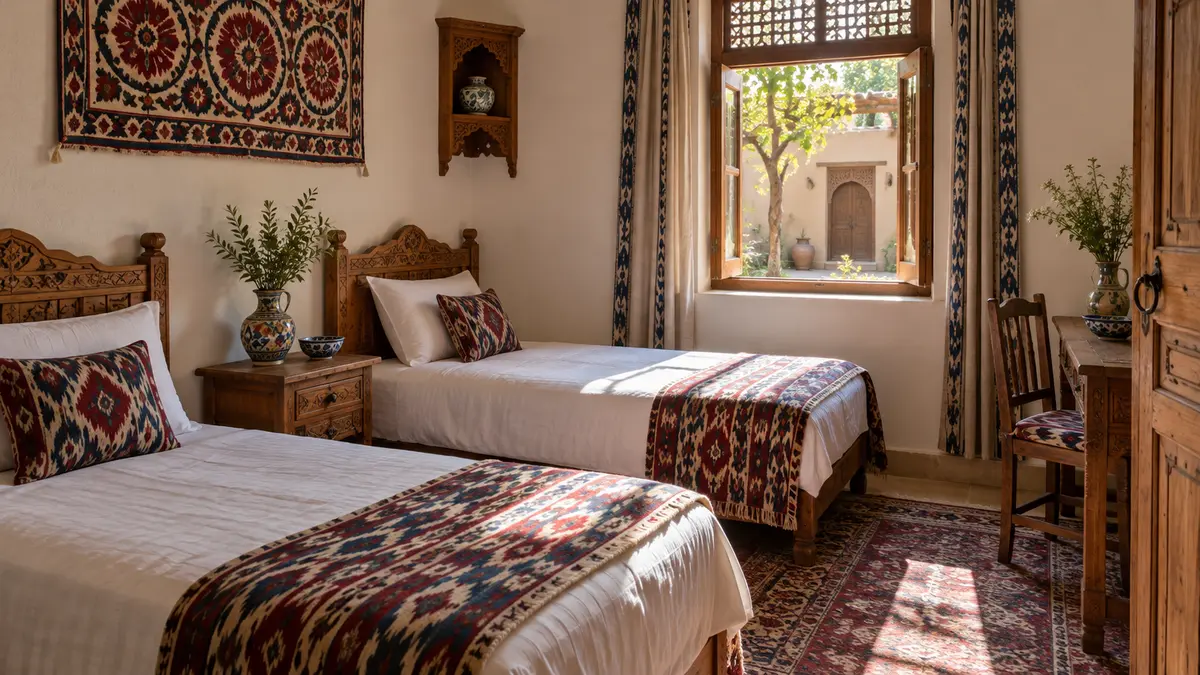
The adjacent visitor area contains one four-star hotel, two three-star hotels and twenty-two family guesthouses with 176 beds. Parking, communication networks and landscaping form other parts of its facilities. The accommodation stands beside the memorial rather than within its prayer building or museum. Individual hotels and guesthouses provide their own rooms and services for overnight stays near the pilgrimage destination.
The twenty-two family guesthouses contain the stated 176 beds. The three hotels form a separate accommodation category. Beds identify overnight provision, while the mosque’s capacity concerns people using a prayer space and the daily service figure concerns the wider facilities. Each measure belongs to a particular part of the destination, with its own unit and interval.
A pilgrim or cultural visitor may spend a short interval at the complex or stay nearby. The accommodation choice determines the evening and morning arrangements, while the visit itself has its own programme. A hotel booking does not automatically include a museum guide, transport from Samarkand or participation in a religious activity.
A tourist centre forms part of the visitor provision around the memorial. The completed facilities also include accommodation, parking, communication networks and landscaped spaces. These support different parts of a journey: arrival, orientation, the visit itself and an overnight stay. The centre and individual providers have their own service arrangements alongside the religious and museum functions of the complex.
Language and interpretation can also affect the visit. A guide explains the scholar, buildings and museum sequence; an accommodation host explains the stay. These are different roles. A visitor seeking a specialist explanation of hadith scholarship should identify that need separately from arranging a room or a transfer.
Craftspeople from Samarkand, Bukhara, Khiva, Tashkent, Andijan, Kokand and Shakhrisabz participated in the 1998 memorial programme. The mausoleum occupied the central axis of that earlier complex. The named cities identify the makers’ backgrounds, while the memorial stands at the scholar’s burial place near Samarkand. The later reconstruction added further architectural and visitor spaces around the destination.
The central-axis description explains a spatial arrangement within the older site. An axis organizes the relationship between entrance, courtyard and principal structure; a later rebuilding can introduce additional spaces around that relationship. A historical plan and a current visitor map therefore have different dates and purposes.
During the Mar 19, 2026 visit, the following day’s Ramadan Hayit prayer was proposed for the new mosque. That was a holiday-service proposal tied to the visit date. The mosque’s permanent role is worship, while the museum presents scholarly history and the nearby accommodation serves overnight visitors. Each function occupies a different part of the reconstructed memorial and visitor area.
The scholar’s burial, the 1998 commemoration and the completed 2026 reconstruction form separate stages in the memorial’s history. Each period introduced its own activity around the destination. The earlier programme involved craftspeople from several Uzbek cities, while the later reconstruction added a large mosque, museum pavilions and visitor accommodation. Research institutions supply another continuing connection with the scholar’s texts.
The mosque’s ten-thousand-person capacity and the wider complex’s daily service capacity concern different intervals. One describes simultaneous use of a prayer building; the other describes how many pilgrims the facilities could serve over a day. Keeping the unit and interval with each number avoids treating them as competing estimates of the same thing.
Samarkand and a wider pilgrimage journey
Samarkand's monumental ensembles provide a different historical setting from the Imam Bukhari memorial. Madrasas, mausoleums and public squares can be studied through their own construction periods and patrons. The memorial's association with a ninth-century scholar adds another subject to a regional journey rather than extending the Registan's architectural history to every nearby destination.
Bukhara supplies the scholar's birthplace connection and another concentration of Islamic architecture and scholarship. A journey between Bukhara and Samarkand therefore links places associated with his life, while also passing through different urban histories. The transfer is geographical; it does not make all monuments along the route part of the same memorial complex.
A pilgrimage route can include worship and remembrance, while a cultural itinerary may concentrate on architecture, texts and institutional history. Individual visitors may combine those purposes. The site has provisions relevant to both, but their actual programme depends on the arrangements made and the uses of the spaces visited.
Imam Bukhari’s burial, the 1998 memorial programme, the research centre established in 2008 and the completed 2026 reconstruction form separate stages in the destination’s history. The new mosque, museum and visitor area add contemporary facilities around the scholar’s legacy. ABA Travel’s Islamic heritage and pilgrimage routes place the Samarkand-region memorial alongside other destinations within a wider Uzbekistan journey.
















Leave a comment